

This article is sponsored by Arkestro and was written, edited, and published in alignment with our Emerj sponsored content guidelines. Learn more about our thought leadership and content creation services on our Emerj Media Services page.
Enterprise procurement leaders are operating in environments characterized by increasing supplier complexity, data intensity, and external volatility. As organizations scale, procurement functions are expected to support cost control, supply continuity, and informed decision‑making under uncertainty.
The GAO has documented the performance gap between strategic and reactive buying in concrete terms. Leading companies strategically manage about 90% of their procurements and report annual savings of 10% or more, while the federal agencies GAO reviewed were managing about 5% of their spend through strategic sourcing efforts.
The operational pressure on procurement functions is intensifying. The Hackett Group’s 2025 Key Issues Study — which benchmarks procurement operations across 97% of the Dow Jones Industrials and 89% of the Fortune 100 — found that procurement workloads are projected to increase 10% while budgets grow just 1%, creating a 9% efficiency gap. According to the same study, 64% of procurement leaders expect AI and generative AI to fundamentally transform their roles within five years.
The OECD’s 2025 Government at a Glance report clearly frames the institutional imperative: modernizing procurement systems is now considered essential, with a central emphasis on digital technologies to increase transparency, responsiveness, and data-driven decision-making.
The case for transformation is real, but the results are not automatic: procurement value depends heavily on data quality, process discipline, and organizational readiness.
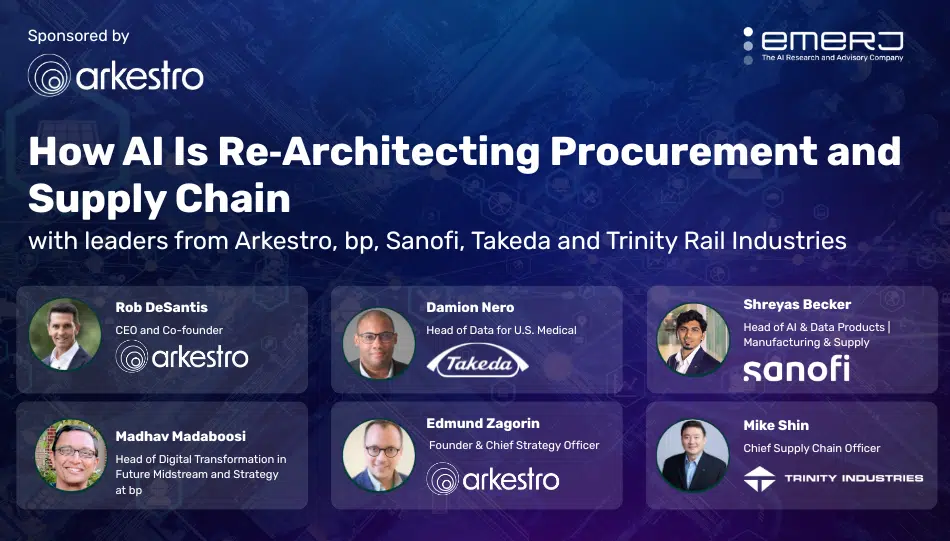
Emerj recently spoke with senior leaders across life sciences, energy, and heavy industry to understand how procurement is shifting from reactive buying to a science‑driven, AI‑enabled strategic function. Featured voices include Rob DeSantis, CEO and Co‑founder of Arkestro; Madhav Madaboosi, Head of Digital Transformation in Future Midstream and Strategy at bp; Mike Shin, Chief Supply Chain Officer at Trinity Rail Industries; Damion Nero, Head of Data for U.S. Medical at Takeda Pharmaceuticals; and Shreyas Becker, Head of AI & Data Products at Sanofi.
These conversations surfaced five procurement‑specific insights that illustrate how AI is reshaping sourcing, supplier management, and operational decision‑making.
- Procurement’s risk posture as the hidden adoption barrier: The same caution that protects supply continuity and supplier relationships also slows AI transformation.
- Dynamic evaluation of sourcing options in unstable markets: Clearer insight into viable local and regional suppliers helps procurement maintain continuity when global routes become unreliable
- Continuous, risk‑based monitoring at scale: Replacing static surveys and episodic assessments with continuous, exception‑based monitoring preserves visibility as supplier networks grow and allows leaders to focus on material risk signals rather than overwhelming volumes of data.
- Bottom‑up adoption as the key to procurement transformation: Demonstrating quick, frontline value through simple, targeted proofs of concept builds the credibility needed to secure long‑term investment.
- Frictionless sourcing as the foundation for predictive procurement: Removing manual data gathering and quote analysis accelerates cycle times and lets teams focus on higher‑value decisions.
Procurement’s risk posture as the hidden adoption barrier
Guest: Rob DeSantis, CEO and Co-founder, Arkestro
Episode: Enabling Strategic Procurement with AI, From Frustration to Foresight – with Rob DeSantis of Arkestro
Expertise: Procurement, Supply Chain Transformation, E-procurement, SaaS Leadership, Strategic Sourcing, Enterprise Software Scaling
Brief Recognition: Rob DeSantis is the CEO and Co-founder of Arkestro, bringing over 30 years of experience to the intersection of enterprise software and supply chain operations. He previously co-founded Ariba, a foundational leader in e-procurement, and served as a member of the early executive team at LinkedIn. Throughout his career, DeSantis has specialized in leveraging emerging technologies to drive measurable step-function value and earnings-per-share impact for global corporations.
Rob DeSantis begins the conversation by drawing attention to a dynamic that rarely gets named explicitly inside large enterprises: procurement’s instinct to protect continuity often slows the adoption of new technology, even when the upside is clear.
Finance pushes for earnings impact; procurement protects supply stability. Those incentives diverge the moment AI enters the conversation.
DeSantis explains that procurement’s caution is not cultural hesitation; it is a structural requirement of the role. A failed experiment can jeopardize supply availability, damage supplier relationships, or expose the organization to compliance risks. That reality makes new technology feel less like an opportunity and more like a potential disruption.
He captures the tension directly:
“Supply chain resists what finance is willing to bet on: every transformative wave — from the internet to cloud to AI — hits a ‘turbo‑lag’ of fear and conservatism, yet the organizations that overcome it capture not incremental gains, but step‑change value that ultimately makes the risk unavoidable.”
– Rob DeSantis, CEO and Co-founder at Arkestro
From there, DeSantis outlines the forces that reinforce this posture:
- Continuity exposure: Any disruption threatens production schedules and customer commitments.
- Supplier relationship sensitivity: Procurement avoids moves that could destabilize long‑standing partnerships.
- Operational overload: Teams are already stretched by data volume and legacy tools, leaving little bandwidth for experimentation.
Finance, by contrast, sees AI through the lens of step‑function savings rather than operational risk. As DeSantis notes, finance leaders are often more willing to take the leap because the potential impact is so large.
This misalignment creates what he calls “turbo lag” — the multi‑year delay between a new technology’s arrival and procurement’s willingness to adopt it. He’s watched the same pattern unfold with the internet, the cloud, and now AI.
Rob emphasizes that overcoming this lag requires acknowledging procurement’s risk posture rather than working around it. Without that recognition, even high‑ROI opportunities stall before they begin.
His strategic takeaway is clear: AI adoption in procurement will not accelerate until leaders actively manage, not ignore, the function’s inherent risk aversion.
Dynamic evaluation of sourcing options in unstable markets
Episode: Scaling Drug Manufacturing from Clinical Trials to Commercial Production – with Shreyas Becker of Sanofi
Guest: Shreyas Becker, Head of AI & Data Products: Manufacturing & Supply, Sanofi
Expertise: Manufacturing AI, Supply Chain Resilience, Tech Transfer, Reasoning Models, Life Sciences Operations, Data Product Management
Brief Recognition: Shreyas Becker is the Head of AI and Data Products for Manufacturing and Supply at Sanofi, leading the integration of reasoning-based AI into high-stakes pharmaceutical manufacturing. He specializes in accelerating the tech transfer phase and building robust data foundational layers to improve supply chain resilience and manufacturing throughput.
What stands out in Becker’s perspective is how quickly he dismisses the idea that today’s volatility is temporary. In his view, the last several years didn’t break the system; they revealed what was already fragile. And once that becomes clear, the question shifts from How do we optimize the old model? to Why are we still using it?
He points out that supply chain teams have spent more than a decade tuning processes for stability that no longer exists. Tariffs, geopolitical shifts, and pandemic‑era disruptions forced organizations to confront the limits of global dependency.
Instead of squeezing out another percentage point of efficiency, teams suddenly had permission, and necessity, to rethink where and how they source.
He puts it plainly:
“For the last 15 years, we’ve been talking about optimization. We rarely talk about redesign. Now we are talking about it. Shocks give you an opportunity to redesign an entire thing so you could leapfrog a lot of the small challenges and make significant gains.”
– Shreyas Becker, Head of AI & Data Products: Manufacturing & Supply, Sanofi
That redesign inevitably changes the sourcing map. Some materials still require specialized global setups, but many others don’t. Becker notes that for commoditized ingredients, suppliers can now differentiate on quality and reliability, not just cost; a shift that makes regional and local options far more competitive than they were five years ago.
AI becomes the mechanism that makes this rethink possible. Not because it automates the old process, but because it can evaluate conditions that the old process was never built to handle. Earlier systems struggled with edge cases; newer models can reason through unfamiliar scenarios, weigh trade-offs, and surface alternatives that weren’t previously visible.
The result is a sourcing function that behaves differently:
- It doesn’t wait for a disruption to reconsider suppliers.
- It doesn’t assume global routes are the default.
- It doesn’t treat volatility as an exception.
Becker’s point is that AI doesn’t just help procurement react faster — it helps procurement see entirely different options, especially when the environment is unstable. Volatility becomes a design input, not a crisis.
Continuous, risk‑based monitoring at scale
Episode: Leveraging Data to Scale Drug Development Globally – with Damion Nero of Takeda
Guest: Damion Nero, Head of Data for U.S. Medical, Takeda Pharmaceuticals
Expertise: Precision Medicine, Data Science, Deglobalization Strategy, Clinical Development, Real-World Evidence, Pharmaceutical Analytics
Brief Recognition: Damion Nero is the Head of Data for U.S. Medical at Takeda Pharmaceuticals, where he leads the strategic application of machine learning and real-world data to global drug development. With over 15 years of experience in precision medicine, he specializes in navigating the transition toward regionalized supply chains and localized data sourcing to maintain profitability in a fragmented global market.
Damion Nero describes a supply‑chain environment where the ground moves faster than the systems built to track it.
Tariffs appear before anyone knows how they’ll be collected, ports stall without warning, and policy shifts outpace the infrastructure meant to enforce them. In that kind of landscape, the traditional rhythm of supplier oversight — scheduled reviews, periodic surveys, episodic assessments — simply can’t keep up.
The deeper issue, in Nero’s view, is that the global model for which those tools were designed is dissolving. The long era of U.S.‑backed free trade is giving way to a more fragmented, regionalized system. New blocs are forming, old alliances are weakening, and supply routes that were stable for decades are becoming unreliable. Pharmaceutical companies can no longer assume that a global supplier will remain accessible, compliant, or even operational.
That shift forces a different posture:
• Supply lines have to shorten.
• Redundancies have to be built locally.
• Procurement teams need visibility that doesn’t arrive weeks or months after conditions have changed.
Continuous monitoring becomes less about sophistication and more about survival — a way to detect the early signs of disruption before they cascade into shortages, delays, or market loss.
Nero makes the stakes clear, and the quote lands best when it closes the section:
“What comes after is really sort of the new world order that’s established. And what that’s looking like, if you look at the larger trend, is de‑globalization. And that’s really what we’re planning around. Global supply is not an option. So what that means is we’re going to have to resource locally. We’re going to have to pull things together at a level that we haven’t done before. Leadership is reluctant because it’s expensive to set up at the outset. But realistically, there may be markets we’re completely shut out of.”
— Damion Nero, Head of Data Science, Takeda Pharmaceuticals
Bottom‑up adoption as the key to procurement transformation
Episode: Operationalizing Portfolio Decisions at Speed and Scale – with Madhav Madaboosi of bp
Guest: Madhav Madaboosi, Head of Digital Transformation in Future Midstream and Strategy, bp
Expertise: Digital Transformation, Portfolio Management, Advanced Analytics, Energy Supply Chain, Change Management, Strategic Innovation
Brief Recognition: Madhav Madaboosi leads the global Digital Transformation Team for Future Midstream and Strategy at bp, where he oversees digital initiatives across supply chain, logistics, and customer-facing operations. With over two decades of experience in AI and advanced analytics, he specializes in bridging enterprise strategy with digital innovation to drive measurable ROI in highly regulated energy environments. His approach emphasizes rapid-turnaround pilots and frontline engagement to operationalize transformation at scale.
Madhav Madaboosi argues that the hardest part of digital transformation isn’t the technology, it’s the organizational physics around it. Large enterprises are under constant pressure to deliver short‑term ROI, and in heavily regulated sectors like energy, license‑to‑operate requirements dominate the agenda.
Compliance work always gets done; value‑creation work often doesn’t. In that environment, long‑horizon analytics programs struggle to gain traction unless frontline teams feel the benefit immediately.
That’s why Madaboosi emphasizes concept labs: small, tightly scoped pilots that run for four to six weeks and require minimal resources. Their purpose is to demonstrate value quickly enough that teams can extrapolate the impact to revenue growth, working‑capital efficiency, or cycle‑time reduction.
A pilot that organizes thousands of contract terms, saves a negotiator twenty hours, or surfaces a better escalation path does more to build momentum than a year of strategy decks. It gives leaders something tangible to scale — and gives frontline users a reason to care.
Adoption, in his view, depends entirely on simplicity. Frontline workers embrace tools that make their specific workflows easier, not ones that add abstraction or overhead. Conversational interfaces, intuitive design, and self‑service analytics are what turn early users into internal advocates. When the product helps them do their work more efficiently, they become the engine of change rather than the obstacle to it.
Madaboosi captures this dynamic directly:
“What is often overlooked is how that change is going to be pushed across the organization. The change is coming from the front lines of the organization and is almost a chain. They become change ambassadors for the rest of the organization, bottom up. The front line of the organization will be aided by this product, as it enables them to do their work more productively. They are only going to embrace that when something is going to help them do their work more efficiently.”
— Madhav Madaboosi, Head of Digital Transformation, bp
In his framing, bottom‑up adoption isn’t a cultural preference; it’s the only reliable path to long‑term investment and scale.
Frictionless sourcing as the foundation for predictive procurement
Episode: What Global Tariff Uncertainty Means for Supply Chain Leaders – with Edmund Zagorin of Arkestro and Michael Shin of Trinity Rail Industries
Guests: Edmund Zagorin, Founder & Chief Strategy Officer, Arkestro
Expertise: Predictive Procurement, AI Strategy, Strategic Sourcing, Supply Chain Resilience, Autonomous Negotiation, Data-Driven Sourcing
Brief Recognition: Edmund Zagorin is the Founder and Chief Strategy Officer of Arkestro, where he pioneered the predictive procurement model, transforming traditional sourcing into a proactive, data-backed function. His work focuses on utilizing AI to simulate complex global scenarios, allowing enterprises to leverage pricing power while mitigating geopolitical and compliance risks. Zagorin provides strategic oversight for Fortune 500 firms aiming to reduce cycle times and achieve step-function savings through autonomous negotiation frameworks.
Guest: Michael Shin, Chief Supply Chain Officer, Trinity Rail Industries
Expertise: Global Procurement, Supply Chain Management, Logistics Operations, Autonomous Sourcing, Digital Twinning, Strategic Leadership
Brief Recognition: Michael Shin is the Chief Supply Chain Officer at Trinity Rail Industries, with over three decades of leadership experience across the industrial manufacturing and energy sectors. Having held senior executive roles at GE and Stanley Black & Decker, he currently oversees the deployment of advanced AI architectures and data science teams to operationalize always-on global procurement . Shin is a leading proponent of digital twinning to institutionalize tribal knowledge and maximize frontline productivity through human-machine collaboration.
Sourcing teams today spend an outsized share of their time on administrative drag — cleaning fragmented data, managing email chains, and manually evaluating quotes. That posture leaves little room for the strategic dialogue required to manage complex global supply bases. Both Edmund Zagorin and Michael Shin argue that this friction is the primary barrier to speed.
Predictive procurement removes that bottleneck. By using AI to automatically analyze thousands of parts, market factors, and supplier conditions, enterprises can approach the market with proactive, data‑backed offers instead of waiting for quotes. This shift compresses cycle times and reallocates human expertise toward judgment, negotiation, and supplier partnership.
Shin extends the argument to talent risk. As manufacturing faces a structural labor deficit, capturing tribal knowledge becomes a strategic imperative. Digital twinning — encoding the logic of veteran buyers and plant managers — turns unwritten tradecraft into scalable best practices. At the same time, AI can surface incumbent alternatives: suppliers already in the portfolio who can serve as substitutes for parts previously thought to be single‑sourced. This strengthens resiliency without expanding the supply base.
That shift forces a different posture:
• Remove manual data gathering and quote analysis.
• Institutionalize expert logic through digital twinning.
• Use AI to identify incumbent alternatives and hidden capacity.
• Reallocate sourcing talent to higher‑value decisions and supplier strategy.
Zagorin captures the acceleration this unlocks:
“Today, the ability to get started, the barriers have never been lower, and the speed at which you can move has never been greater. In five days, you can get projects live with suppliers and begin moving spend and demand from a reactive manual posture to something that’s running continuously and predictively.”
— Edmund Zagorin, Founder and Chief Strategy Officer, Arkestro
Frictionless sourcing isn’t just efficiency — it’s the operational foundation that makes predictive procurement possible.