

Drug development remains one of the most capital-intensive activities in life sciences. A 2021 peer-reviewed study published in Clinical and Translational Science found that the success rate of a drug candidate from the start of clinical trials to marketing approval sits at roughly 10–20% and has not meaningfully changed in decades.
A separate analysis published in JAMA and indexed by the National Institutes of Health found that Phase III trials account for the largest share of clinical development costs, driven by larger patient enrollment and longer trial durations than in earlier phases.
Many of these costs stem from decisions made with fragmented evidence — dose selection based on limited early-phase data, safety signals assessed in isolation, and patient variability understood only after large trials are already underway.
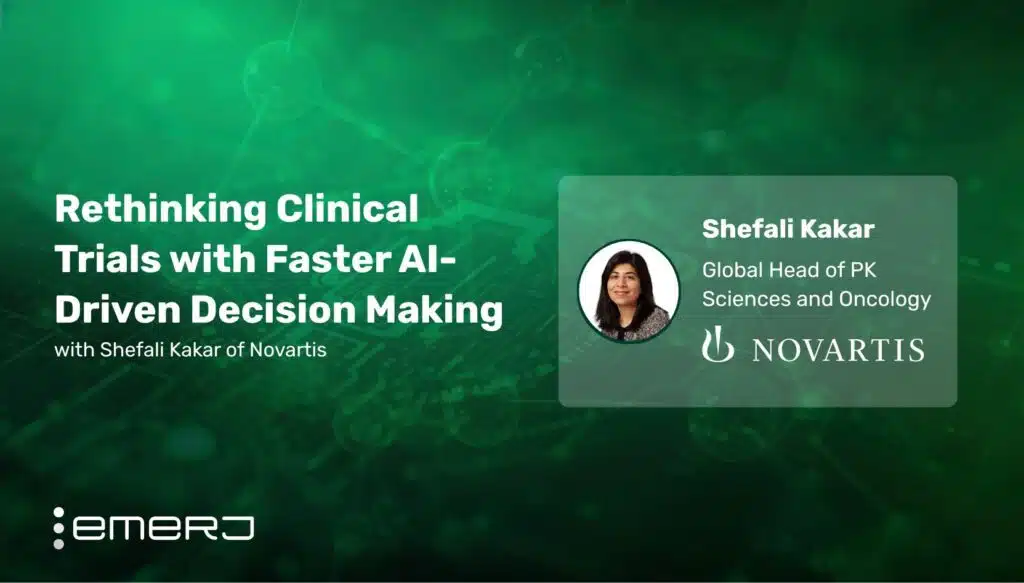
In a conversation between Emerj’s Matthew DeMello and Shefali Kakar, Global Head of PK Sciences and Oncology at Novartis, the discussion defines how AI is transforming drug development by giving enterprises earlier clarity on program viability and a more precise understanding of real patient impact — two levers that directly influence speed, risk, and capital allocation across the R&D portfolio.
This article explores two of Shefali Kakar’s core insights for enterprise teams navigating AI‑enabled drug development:
- Accelerating development decisions to improve capital focus: Earlier clarity on program viability enables faster go/no‑go choices and tighter alignment of resources to the opportunities with the strongest evidence.
- Deepening patient insight to strengthen program design: A clearer view of how individual patient characteristics affect drug response supports safer, more targeted trials and builds a stronger evidence base across development phases.
Episode: Rethinking Clinical Trials with Faster AI-Driven Decision Making – with Shefali Kakar of Novartis
Listen to the full episode below:
Guest: Shefali Kakar, Global Head of PK Sciences and Oncology at Novartis
Expertise: Clinical Pharmacology, Oncology Drug Development, Pharmacokinetics/Pharmacodynamics (PK/PD), Biologics & Immuno-oncology
Brief Recognition: Shefali Kakar leads global PK Sciences and Oncology at Novartis, where she drives clinical pharmacology and dose optimization strategy across oncology programs, including biologics and immunotherapies. Over nearly two decades at Novartis, she has held progressive leadership roles from Fellow to Executive Director, shaping PK/PD modeling and evidence integration approaches across respiratory and oncology portfolios. Prior to Novartis, she served as a Senior Principal Scientist at Pfizer, contributing to drug metabolism and clinical pharmacology programs. She holds a Ph.D. in Clinical Pharmacology from the University of Michigan.
Accelerating Development Decisions to Improve Capital Focus
Kakar opens the discussion by contrasting the slow, sequential decision patterns that have long shaped drug development with the more integrated, evidence-driven approach AI now makes possible.
Historically, teams advanced dose and program decisions step by step — Phase I, then Phase II, then Phase III — each stage waiting on the last and each relying on narrow slices of data. As Kakar makes clear, this structure often forces organizations to commit capital before they have a complete picture of viability.
From there, she describes how AI-enabled modeling changes the economics of development. Instead of treating each phase as a discrete gate, teams can now evaluate evidence across studies and identify viable dosing strategies earlier in the process — sometimes surfacing answers that large, dedicated trials were never designed to produce. Kakar points to a case where integrated modeling across a modest dataset revealed something a full Phase III comparison had not:
“We had a Phase III study where a particular dose was investigated, but when we looked at all of the data collectively and modeled it out, it became clear that whether the drug was given once a day or twice a day with the same total dose, we ended up with the same efficacy. This was not something that was investigated in a very large Phase III trial — it came from modeling across a more modest dataset. That is the kind of answer you can only get when you stop treating dose as a fixed choice at each phase and start looking at it as a continuum across the full evidence base.”
— Shefali Kakar, Global Head of PK Sciences, Oncology at Novartis
This ability to revisit assumptions using the full body of evidence — even after Phase III — represents a direct departure from the historical “pick one dose and commit” paradigm. It reduces the need to test every permutation in large trials and gives teams earlier clarity on whether a program is on the right track.
For enterprise teams, the pattern Kakar describes — earlier clarity on dose viability, fewer large confirmatory trials, and the ability to revisit assumptions across phases — naturally leads to faster go/no‑go decisions and tighter alignment of capital to the opportunities with the strongest evidence.
Deepening Patient Insight to Strengthen Program Design
One of the themes Kakar returns to is how little visibility teams have traditionally had into the patient‑level factors that shape drug exposure. Instead of a unified view across studies, organizations often worked from small, standalone impairment cohorts that were never powered to reveal how characteristics like kidney or liver function meaningfully altered response. The result wasn’t just slow learning — it was fragmented learning, with each study offering only a partial picture of how real patients would fare.
AI‑enabled modeling gives teams a way out of that fragmentation. By pooling patient‑level data from large Phase III trials, teams can examine how specific covariates influence exposure or adverse events without running a separate sub‑study for each question. The insight comes from the evidence already in hand, not from a new, narrowly scoped experiment.
Kakar describes how this shift has changed dose decisions in practice:
“In the past, we would run a separate study just to understand how kidney impairment affected drug exposure. Now we can embed that question directly into the Phase III trial — look at the patients already enrolled, examine how their kidney function correlates with exposure or adverse events, and use that to determine whether a dose adjustment is needed. What used to require its own cohort now comes from the data we already have.”
— Shefali Kakar, Global Head of PK Sciences and Oncology at Novartis
For Kakar, this is the real value of integrated modeling: earlier clarity on how different patient groups respond, and the ability to adjust dose or monitoring expectations before those differences become late‑stage surprises.