

This article is sponsored by Akur8 and was written, edited, and published in alignment with our Emerj sponsored content guidelines. Learn more about our thought leadership and content creation services on our Emerj Media Services page.
The global insurance sector faces intensifying pressure to modernize pricing and reserving functions as legacy infrastructures struggle to maintain pace with market volatility and shifting regulatory standards.
According to the IAIS, this flashpoint is driven by escalating climate-related risks and geoeconomic fragmentation, which are significantly increasing liabilities across non-life lines, as reported in their 2025 Global Insurance Market Report.
While many Tier 1 and Tier 2 insurers have moved beyond the initial experimentation phase with AI, the transition to enterprise-ready deployment remains hindered by a reliance on fragmented manual processes; BCG’s The Widening AI Value Gap claims that currently, only 5% of global enterprises are achieving substantial bottom-line value from AI at scale.
Recent industry shifts emphasize that the primary challenge for non-life insurers has shifted from building accurate models to operationalizing them within frameworks that ensure precision, transparency, and compliance with emerging state-based oversight, such as the NAIC’s FACTS doctrine.
For actuarial teams, this requires a dual focus: maintaining the rigorous standards of actuarial science while introducing automation and machine learning directly into deeply entrenched workflows.
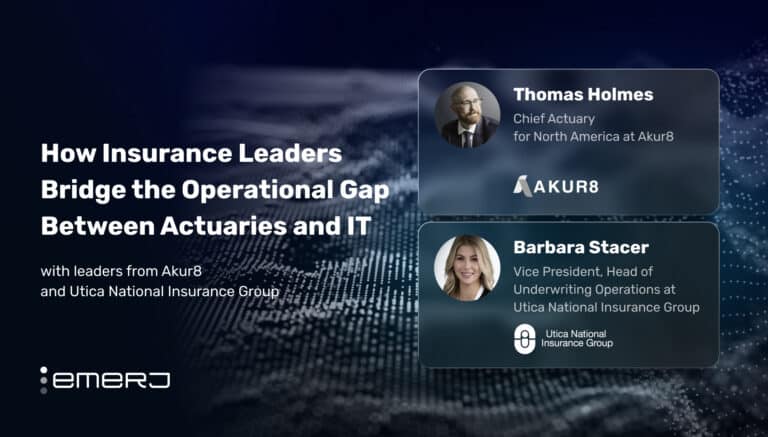
Emerj recently hosted executive conversations to address these transformation hurdles, featuring leaders at the intersection of actuarial science and underwriting operations. The series featured Thomas Holmes, Chief Actuarial Officer at Akur8, and Barbara Stacer, Vice President and Head of Underwriting Operations at Utica National Insurance Group.
This article brings forward the core modernization priorities insurers can act on now:
- Prioritizing actuarial soundness over technological novelty: Modernization must respect the code of conduct and rigorous precepts of the actuarial profession to avoid total organizational rejection.
- Implementing opinionated AI frameworks: Moving from a sandbox to production requires setting guardrails that dictate default problem-solving methods, ensuring consistent governance across the enterprise.
- Establishing a single source of truth for ratings: Eliminating manual rate recoding between actuarial modeling and IT execution reduces errors and accelerates speed-to-market.
- Adopting the workflow rails strategy: Utilizing a hybrid approach that purchases operational infrastructure while building unique underwriting differentiation allows for safe, predictable deployment.
- Solving the translation gap in pricing: Identifying where pricing changes “wait” during documentation and approval cycles is critical to preventing premium leakage.
Prioritizing Actuarial Soundness over Technological Novelty
Episode 1: Modernizing Insurance Pricing From Excel to Explainable AI
Guest: Thomas Holmes, Chief Actuarial Officer at Akur8
Expertise: AI Governance, Enterprise Deployment, Regulatory Compliance, Actuarial Rigor, Modernization Strategy, Pricing Innovation
Brief Recognition: Thomas Holmes is Chief Actuary for North America at Akur8, where he helps insurers operationalize machine learning in pricing and actuarial workflows and guides product development for the U.S. market. He previously spent seven years at Allstate in actuarial leadership roles and volunteers with the Casualty Actuarial Society on predictive modeling initiatives. Holmes is a Fellow of the CAS and co-authored CAS Monograph 13 on penalized regression and Lasso credibility.
Insurance modernization often begins with a critical evaluation of the status quo. For decades, Excel has remained the dominant tool for actuarial analysis due to its perceived transparency and flexibility. However, Thomas argues that this familiarity creates a false sense of security, as manual spreadsheets are often opaque, lack version control, and offer limited flexibility in a modern production environment.
Transformation begins by redesigning the underlying calculation approach, not by upgrading tools around an outdated foundation. Transformation begins by rebuilding the underlying calculation approach, not by layering new technology onto outdated foundations.
A non-negotiable threshold for this transition is actuarial soundness. Holmes emphasizes that if an AI tool threatens the integrity of results or deviates from established precepts, it will encounter a hard stop from the actuarial team:
“Actuarial usage is very specific. A lot of these algorithms are generic, off-the-shelf, and they will fail when hitting insurance problems, because there’s a lot of nuance, there’s a lot of real-world considerations, there’s a lot of situations where the data lies to you. And that’s one of the reasons that actuaries have jobs, is because the data lies, and we have to point out where that’s happening, adjust the model, how to fix it, and when it’s all within an AI, we get skeptical.”
– Thomas Holmes, Chief Actuary for North America at Akur8
Successful modernization requires moving beyond the cool factor of AI to deliver concrete, cold, hard numbers that satisfy leadership. Leaders must identify very specific problems to solve rather than adopting technology out of a generic fear of missing out. By reinventing how pricing is handled, firms can retain what works well while gaining entirely new capabilities.
Implementing Opinionated AI Frameworks
Episode 2: Translating AI Models into Business Value From Governance to Deployment
Guest: Thomas Holmes, Chief Actuarial Officer at Akur8
As insurers move from experimentation to enterprise deployment, the focus shifts to operationalizing AI within governance frameworks that satisfy both regulators and internal stakeholders. Holmes introduces the concept of an opinionated framework as the primary tool for managing this transition.
Opinionated frameworks set structures and default pathways for solving insurance‑specific problems with AI, customized to the needs of the industry:
Set a Clear Problem Statement: Modernization must begin with a targeted operational problem, not with technology driven by novelty or internal pressure.
Define Initial Process and Checks: Establish the first step of the AI workflow and the validation checks needed to ensure the output is actuarially sound from the start.
Edit and Refine: Allow for human‑in‑the‑loop adjustments where experts can account for nuances the data may obscure.
Execute Subsequent Steps and Final Checks: Advance through the final modeling stages with industry guardrails that keep the outcome transparent and explainable to regulators.
By limiting total flexibility in favor of a guided process, firms inherently build a governance structure — essential in insurance, where pricing decisions carry regulatory and financial consequences. Generic AI models may be acceptable for low‑stakes applications, but pricing requires transparency to avoid dislocation and maintain trust.
Because AI methods evolve quickly, no static governance checklist can keep pace. An opinionated framework ensures that, even as techniques shift, outcomes remain actuarially aligned, explainable, and suitable for enterprise deployment. Its purpose is to make it difficult for an organization to produce a flawed result without noticing it, enabling leaders to reconcile innovation with regulatory expectations and scale AI responsibly across the enterprise.ise while maintaining the trust of both executive leadership and policyholders.
Establishing a Single Source of Truth for Rating
One of the most significant sources of error and delay in insurance is the “translation gap” between actuarial modeling and IT implementation. Traditionally, once an actuary completes a pricing model, the results are handed off to IT teams for manual re-coding into a rating engine. This redundancy creates multiple versions of the truth: one in Excel, one in a filing, and one in the production engine, which complicates version control and increases operational risk.
A successful modernization strategy requires a single source of truth. The core rate calculation logic should be an object owned by the actuary and ingested directly by the IT system. This eliminates the need for manual re-implementation and ensures that the approved model is exactly what is deployed in the market, synchronized across all departments.
This central source of truth simplifies governance by eliminating the need for separate versioning structures across different areas. It also enables more seamless scenario analysis and approvals, as the test object is the same one pushed to production. By removing the unnecessary redundancy of manual re-coding, insurers can significantly reduce the risk of implementation errors.
Furthermore, establishing a single source of truth empowers actuarial teams to take ownership of the part of the process they are truly responsible for: the rating order of calculation. IT remains critical for testing and integration, but the core business logic remains under the control of those who built the model. This alignment ensures that actuarial accuracy translates directly into financial performance without loss of precision during handoffs.
Adopting the Workflow Rails Strategy
Episode 3: Pricing Changes in Small Commercial Without Governance Debt
Guest: Barbara Stacer, VP, Head of Underwriting Operations at Utica National Insurance Group
Expertise: Operational Efficiency, Underwriting Workflows, Process Modernization
Brief Recognition: Barbara Stacer is the Vice President and Head of Underwriting Operations at Utica National Insurance Group, where she oversees small commercial and underwriting strategy. With nearly 20 years of experience in the insurance industry, she has held pivotal leadership roles, including serving as Chief Insurance Officer at weSure and holding various director-level positions focused on business solutions and process improvement. Stacer holds a B.S. in Business Administration, Management, and Operations from Keuka College.
While modeling is often blamed for slow pricing cycles, Stacer notes that the bottleneck typically occurs after actuarial work is complete. Time is lost in the limbo space of spreadsheets, manual documentation, and non-traceable approvals that follow a rate indication.
“So I’ve seen where a rate change may be approved, but sit for weeks due to incomplete documentation, unclear ownership or non-traceable assumptions, and the impact that that has is premium leakage, delayed responsiveness and really an inconsistent risk selection for my underwriters, so what I’m seeing is where versioning becomes more automatic, approvals become more traceable, documentation is created alongside with the change, and what I’m seeing that do is it allows leaders to move from explaining the pricing decisions to implementing them faster.”
– Barbara Stacer, VP, Head of Underwriting Operations at Utica National Insurance Group
Stacer advocates for a hybrid model based on workflow rails. In this strategy, carriers purchase the non-differentiating operational infrastructure — the rails — while building their unique underwriting differentiation — the trail — on top of it. Workflow rails allow the pricing change to move from idea to production consistently, safely, and predictably.
Effective workflow rails provide several key benefits to the underwriting organization:
- Automatic Versioning: Ensuring every iteration of a pricing model is tracked without manual intervention.
- Traceable Approvals: Creating a clear audit trail of who approved a change and why, which is essential for regulatory compliance.
- Integrated Filing Preparation: Generating documentation that is structured and ready for regulatory filing alongside the pricing change.
- Reduced Premium Leakage: Accelerating the move to usable pricing prevents revenue loss from delayed rate implementation.
No carrier achieves a competitive advantage solely by building the world’s best approval routing engine. Competitive advantage is found in better risk segmentation and faster market response. By buying the rails, insurers eliminate the operational friction that slows down these core strategic activities.
Solving the Translation Gap in Pricing
The translation gap represents the period when a rate change is approved but sits for weeks due to incomplete documentation or unclear ownership. This gap leads to premium leakage, delayed responsiveness, and inconsistent risk selection for underwriters. To solve this, insurers must look beyond the modeling layer to modernize the workflows and controls surrounding it.
Barbara Stacer recommends an immediate, actionable step for leaders: map one painful pricing cycle to identify exactly where the work wait. This diagnostic exercise reveals the specific bottlenecks — whether in filing preparation, documentation, or IT re-coding — that prevent a carrier from realizing the pricing they intend to achieve.
Strategic takeaways for bridging the translation gap include:
- Mapping Bottlenecks: Identifying precisely where approvals stall or where data must be manually reformatted for different stakeholders.
- Defining Ownership: Clarifying who is responsible for each stage of the translation from model indication to production-ready file.
- Leveraging Vendor Expertise: Partnering with specialized providers who understand specific insurance problems and can provide the necessary rails for speed and governance.
- Configuring for Differentiation: Focusing internal resources on what protects competitive advantage while automating routine governance tasks.
Successful AI adoption in pricing and reserving requires moving from scattered implementations toward this focused, problem-oriented strategy. By addressing the translation gap, insurers can ensure that the truth derived in the modeling phase reaches the market, driving both operational efficiency and financial gain. Establishing these execution pathways is the final step in modernizing the actuarial value chain for the year 2026 and beyond.