

This article is sponsored by Eightfold and was written, edited, and published in alignment with our Emerj sponsored content guidelines. Learn more about our thought leadership and content creation services on our Emerj Media Services page.
Large enterprises are entering a period where operational performance, transformation timelines, and competitive advantage are constrained more by workforce capability than by capital or strategy.
The Conference Board warns that the United States faces a structural labor shortage requiring 4.6 million additional workers per year to maintain current economic output, with shortages even more severe in advanced economies globally. This scarcity is not limited to entry‑level roles; it affects the technical, digital, and operational positions that underpin enterprise transformation.
Sector‑specific research reinforces the scale of the problem. The Manufacturing Institute in partnership with Deloitte project 2.1 million unfilled manufacturing jobs by 2030, driven by a widening skills gap that threatens production continuity, automation initiatives, and safety‑critical operations.
In parallel, Georgetown University’s Center on Education and the Workforce estimates that the U.S. economy will face a shortfall of 5.25 million workers with postsecondary education by 2032 — a deficit concentrated in the very roles required for digital transformation, advanced engineering, and AI‑enabled operations.
Academic research connects these shortages directly to enterprise performance. The Kenan Institute of Private Enterprise identifies the skills gap as a top constraint on U.S. business competitiveness, noting that the mismatch between employer demand and workforce capability is now a systemic barrier to innovation, productivity, and growth.
For enterprise operators, the implication is clear: transformation, automation, and operational excellence are now limited not by strategy but by the inability to see, mobilize, and develop the workforce at scale. This is the business problem Eightfold is built to solve — and it is one of the most economically and operationally consequential challenges facing large enterprises today.
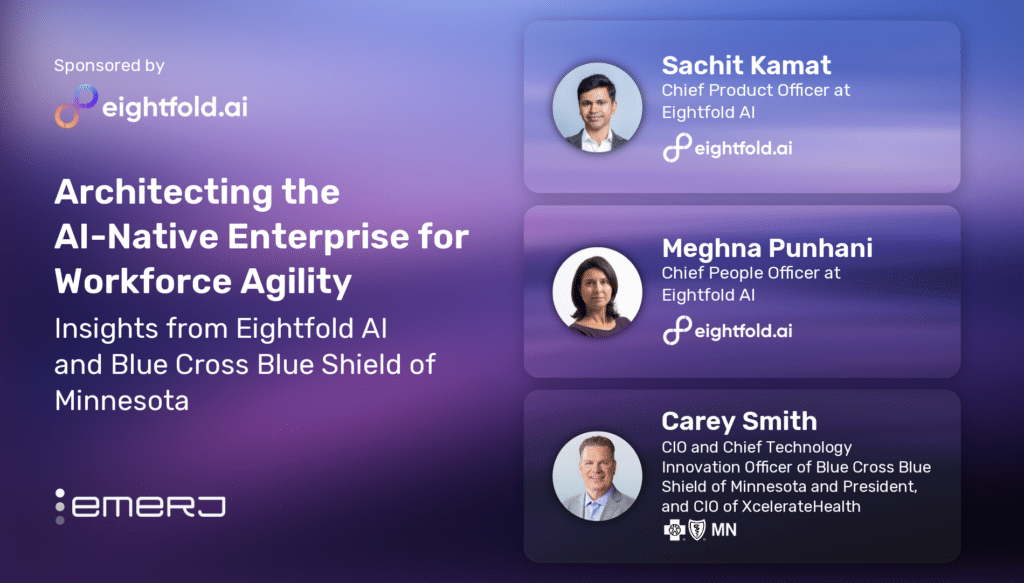
Emerj recently hosted conversations with Sachit Kamat, Meghna Punhani, and Carey Smith on the AI in Business Podcast, each offering a different vantage point on how AI is reshaping enterprise performance. Across the three episodes, the unifying question was how AI‑native operating models, talent intelligence, and organizational redesign are redefining workforce capability, cost structure, and execution for large, complex enterprises.
This article examines the emerging shifts redefining how enterprises build, deploy, and manage their workforces in an AI‑native operating environment:
- Agentic AI shifts talent operations to machine scale: Moving from human-limited processes to autonomous systems that automate interviews, assessments, and internal mobility to deliver faster decisions and measurable HR ROI.
- Skills intelligence drives workforce agility: Connecting employee skills to business needs through AI-powered career mapping and reskilling to enable continuous redeployment and adaptability across shifting priorities.
- Governance-first AI ensures enterprise trust: Embedding compliance guardrails, bias mitigation, and human-in-the-loop controls from day one, allowing enterprises to scale talent AI with the governance required for defensible, ethical, and compliant decision‑making.
Agentic AI Shifts Talent Operations to Machine Scale
Episode 1: Agentic AI & the Strategy Behind Smarter Talent Decisions – with Sachit Kamat of Eightfold AI
Guest: Sachit Kamat, Chief Product Officer at Eightfold AI.
Expertise: Talent Intelligence Systems, AI‑Driven Talent Matching, Enterprise Internal Mobility, Global Skills Architecture
Brief Recognition: Sachit Kamat is the Chief Product Officer at Eightfold AI, where he has helped scale one of the largest native‑AI talent platforms serving roughly a third of the Fortune 500. He previously led LinkedIn’s Jobs marketplace to over $1B in revenue and oversaw the LinkedIn Profile, one of the most widely used professional identity products globally. Sachit holds an MBA from INSEAD and a master’s in Computer Science and Engineering focused on AI and robotics.
Sachit identifies a structural “speed limit” in the modern enterprise: human throughput. Traditional hiring and internal mobility are hardwired for sequential, manual effort, where every screening call and interview depends on an available slot in a recruiter’s calendar. This design flaw creates a ceiling on organizational agility, dictating how slowly a company can respond to market shifts.
Kamat defines an AI agent as software capable of executing a workflow end‑to‑end without human presence; in a talent context, this moves the enterprise from a bottlenecked process to a parallel one.
Agents can conduct structured interviews with hundreds of candidates simultaneously, surfacing only those who merit human evaluation. By eliminating scheduling as a gating factor, Kamat argues that enterprises can finally provide a high‑touch experience to every qualified applicant, a feat previously impossible at the human scale.
The same mechanics extend to internal talent. Kamat describes using voice agents to hold human‑like conversations with employees to validate skills and identify transferable capabilities. This shifts internal mobility from a manager‑driven process — limited by visibility and time — to a data‑driven matching system that can operate continuously. For enterprise leaders, this enables redeployment with the same agility seen during the rapid workforce shifts of the COVID‑19 era.
“In a lot of ways, change management is about rethinking how you should optimize for these different types of workflows, and optimizing for the things that AI is good at versus the things that humans are good at… what we have seen in practice as working well is a situation where you rethink processes from the ground up.”
– Sachit Kamat, Chief Product Officer at Eightfold AI
A useful decision framework for leaders is to categorize workflows by their inherent operational value, ensuring that AI and humans are deployed where they are most effective. This division of labor allows enterprises to scale hiring and mobility capacity without increasing cost or risk:
- Agentic Execution: For structured, repetitive, or coordination‑heavy tasks, such as initial screening and complex scheduling.
- Human Responsibility: For work requiring contextual interpretation, high-stakes negotiation, or careful final selection.
By clearly separating these functions, Kamat notes that organizations can fundamentally “flip the script” toward experiences that weren’t possible at the human scale, transitioning instead to a model defined by machine-scale efficiency and reach.
Skills Intelligence Drives Workforce Agility
Episode 2: From Hiring to Growth and the Future of Workforce Strategy – with Meghna Punhani of Eightfold AI
Guest: Meghna Punhani, Chief People Officer at Eightfold AI
Expertise: Organizational Transformation Leadership, Cross‑Functional Execution Systems, Workforce Capability Development, Data‑Driven Operational Strategy
Brief Recognition: Meghna Punhani is Eightfold AI’s Chief People Officer, bringing senior leadership experience from Google, Palo Alto Networks, and DevRev, where she led large‑scale organizational transformation, workforce modernization, and enterprise‑wide employee experience initiatives. She has guided global operations across complex, high‑growth environments, partnering with C‑suite leaders to redesign operating models, elevate culture, and align talent strategy with business outcomes. Punhani’s academic background includes executive education at Stanford Graduate School of Business and additional study at MIT.
Meghna begins with the blunt assessment that enterprises are over‑invested in functional expertise and under‑invested in adaptability. Technical skills now depreciate faster than the roles built around them, leaving organizations optimized for problems that no longer exist. The real advantage lies in how quickly talent can move as business needs shift.
Punhani notes that AI is already reshaping HR work itself. At Eightfold AI, 70–80% of interviews are now conducted by AI, allowing recruiters to focus on evaluation rather than screening. When employees can access high‑quality guidance from AI systems, HR’s value shifts from answering questions to shaping organizational design and workforce strategy. This transition reframes what organizations should optimize for: not static expertise, but the capacity to grow into new roles as the business evolves.
She emphasizes that the most durable predictors of success are no longer technical credentials but behavioral indicators of adaptability. She highlights three traits that consistently differentiate high performers:
- Curiosity, reflected in the ability to ask the right questions
- Learning agility, demonstrated through cross‑functional movement
- Risk tolerance, shown in willingness to take on unfamiliar challenges
“Functional expertise… does not matter so much anymore. It’s the deeply human skills — curiosity, learning agility, adaptability, collaboration, the ability to take risk — that make humans highly valuable. The more we enhance these skills and use them to our advantage, the more marketable and malleable we become.”
– Meghna Punhani, Chief People Officer at Eightfold AI
Punhani stresses that AI adoption requires rethinking how work is sequenced and where humans add unique judgment. Her own career illustrates this convergence — moving from software development to customer success to HR technology to CIO‑level work — a path enabled by adaptability rather than static expertise. She notes that HR and IT are no longer separate domains; they are co‑architects of machine‑augmented organizations.
Skills intelligence becomes the connective tissue that allows leaders to redesign roles and mobility pathways. By identifying “adjacent skills,” AI systems surface non‑obvious transitions that predict success in a different role, even if the candidate lacks traditional credentials. This shifts mobility from a discretionary process to a structured capability, allowing leaders to fill roles internally with greater confidence.
Governance‑First AI Ensures Enterprise Trust
Episode 3: Funding Agentic AI in HR Without Losing Control – with Carey Smith of Blue Cross and Blue Shield
Guest: Carey Smith, CIO and Chief Technology Innovation Officer of Blue Cross Blue Shield of Minnesota, and President and CIO of XcelerateHealth
Expertise: Enterprise Operating Model Transformation, AI‑Native Value Realization, Cost & Margin Optimization, Large‑Scale Technology Modernization
Brief Recognition: Carey Smith is a multi‑time CIO, COO, and President who has led enterprise transformations across multi‑billion‑dollar operating environments, including Blue Cross Blue Shield of Minnesota and the health‑tech venture XcelerateHealth. He has driven large‑scale operating model redesign, AI‑native value creation, and cost and margin expansion across complex, regulated industries, and has delivered successful technology modernizations and PE‑backed exits in prior CIO and CTO roles. Smith’s academic background includes study in Information Technology and Psychology, along with executive education at MIT Sloan.
Carey identifies a consistent failure pattern as enterprises move from experimentation to real deployment: talent AI breaks because organizations underestimate the accountability burden attached to workforce decisions, rather than a weakness in the underlying technology.
In HR, a black‑box system is not a technical inconvenience, it is a legal, cultural, and reputational risk. Fragmented HR data, rising regulatory scrutiny, and unclear decision pathways create an accountability gap that can erode trust before AI ever delivers value.
Smith notes that the question for 2026 is no longer whether AI can accelerate talent workflows, but whether it can do so without introducing bias, opacity, or regulatory exposure. Employees are skeptical of opaque systems influencing their careers, and regulators expect explainability. Without transparent governance, enterprises end up trading efficiency for enterprise risk. In his view, the absence of governance is the fastest way to stall adoption.
He offers a framing that resonates with enterprise leaders: agentic AI in HR should function like a “Chief Workforce Analyst”, continuously scanning, simulating, and advising, but always operating within policy boundaries. The value is orchestration, not autonomy. The organizations that struggle are the ones still running pilots. Pilots test features; architecture defines how AI will behave across the enterprise.
“With the rapid pace of AI maturity, we need to stop piloting and start architecting. We have to move beyond the cool HR tech demos and build a governance‑first framework — start with governance, not the tools. That means defining decision rights, bias thresholds, explainability standards, and auditing mechanisms before deployment, narrowing early use cases to areas like workforce planning and skills adjacency, and building a human‑plus‑AI operating model where AI recommends, and leaders decide.”
– Carey Smith, CIO and Chief Technology Innovation Officer of Blue Cross Blue Shield of Minnesota, and President and CIO of XcelerateHealth
Smith outlines the tactical first moves that determine whether talent AI becomes an asset or a liability:
- Define decision rights so that it’s clear where AI can act and where humans must intervene.
- Set bias thresholds and explainability standards before any model touches a workflow.
- Establish audit mechanisms that capture how recommendations were generated.
- Integrate HR data silos to give AI a single source of truth.
- Start with narrow, lower‑risk use cases such as workforce planning, internal mobility, and skills adjacency mapping.
- Adopt a human‑plus‑AI operating model where AI recommends, and leaders decide, supported by compliance audits and HR‑owned adoption.
Carey’s guidance converges on a single idea: governance is what makes AI scalable. When decision rights, bias controls, and data foundations are defined upfront, AI becomes a strategic asset. When they are not, adoption stalls and trust erodes. The organizations that succeed are the ones that build systems where AI accelerates insight, humans retain authority, and every decision can stand up to scrutiny.