

This article is sponsored by IFS and was written, edited, and published in alignment with our Emerj sponsored content guidelines. Learn more about our thought leadership and content creation services on our Emerj Media Services page.
A widening gap has emerged between industrial enterprises’ ambitions for AI and their ability to operationalize it; this gap is manifesting in productivity losses, stalled initiatives, and avoidable operational costs that directly erode margins and competitiveness.
Research summarized by MIT Sloan, drawing on U.S. Census Bureau data from tens of thousands of manufacturing firms, shows that organizations adopting AI experience an initial 1.33‑percentage‑point decline in productivity, driven by misalignment between new AI systems and existing processes and workflows.
Meanwhile, the operational vulnerabilities that AI is intended to address remain costly and persistent. Analyses from the National Institute of Standards and Technology (NIST) estimate that U.S. manufacturers incur $18.1 billion in preventable downtime losses annually as part of a broader $119.1 billion in avoidable maintenance‑related costs, driven by reactive maintenance, defects, delays, and inventory disruptions.
These are precisely the categories of operational instability that AI‑enabled predictive and prescriptive systems are meant to reduce, yet they remain largely unmitigated when AI cannot be effectively integrated into existing workflows.
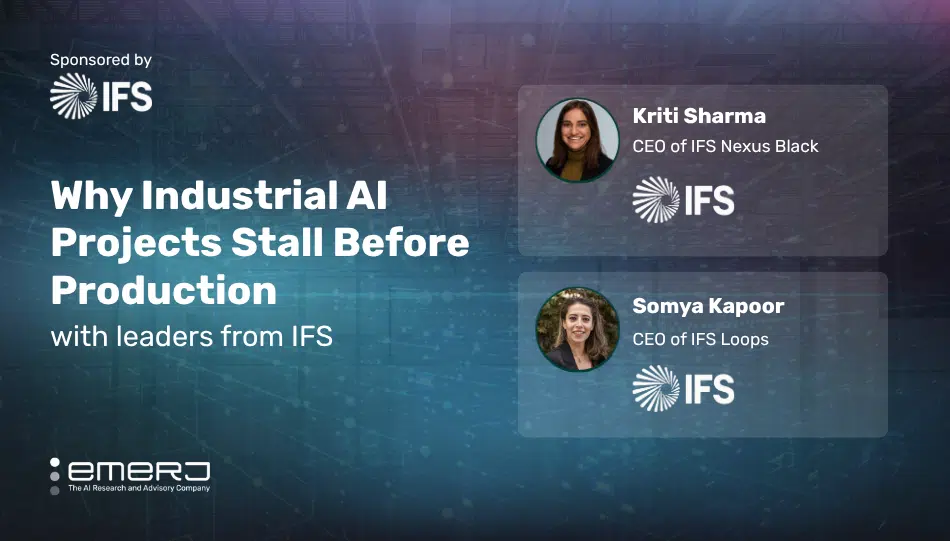
Emerj recently spoke with IFS executives to discuss how asset-intensive industries can bridge the GenAI divide. Leaders featured include Kriti Sharma, CEO of IFS Nexus Black, and Somya Kapoor, CEO of IFS Loops. During these conversations with Emerj Editorial Director Matthew DeMello and CEO Daniel Faggella, three key themes came to the fore:
- Accelerating time-to-value through high-velocity deployment: Moving from multi-year implementations to three-week production-grade results.
- Scaling digital workforces to preserve institutional knowledge: Preserving institutional knowledge as senior technicians retire at record rates.
- Implementing governance via supervisor agent frameworks: Utilizing “Supervisor Agents” to monitor autonomous workflows and mitigate hallucination risks.
Accelerating Time-to-Value through High-Velocity Deployment
Episode: Solving Hard Industrial Problems with Fast AI Deployment – with Kriti Sharma of IFS Nexus Black
Guest: Kriti Sharma, CEO, IFS Nexus Black
Expertise: AI Engineering, Industrial Environments, Rapid Product Development
Brief Recognition: Kriti Sharma is the CEO of IFS Nexus Black. A pioneer in AI for women, she previously served as VP of Artificial Intelligence at Sage and founded the AI for Good initiative to develop ethical autonomous systems. Kriti holds a Master’s in Computer Science from University College London (UCL) and currently spearheads the strategic Anthropic partnership for IFS.
Kriti Sharma explains that many industrial teams have lost patience with long AI programs that never make it to production. Her approach begins by placing engineers directly in the operational environment, where the real constraints live — last-minute orders, unexpected absences, emergency repairs, and the constant reshuffling that make production planning one of the hardest unsolved problems in industry.
Working on the floor allows teams to find the data that actually governs the process, SCADA signals, P&ID diagrams, sensor streams, pressure, temperature, vibration, and to build tools that reflect the true complexity of the system rather than a laboratory abstraction. This proximity also reveals the operational patterns that drive downtime and reactive work, enabling earlier intervention and increased throughput.
Kriti describes the path to autonomy as incremental rather than all‑or‑nothing:
“Production planning is still a hard problem. You’ve got last‑minute orders, someone goes off sick, and a repair throws the whole plan out of whack. You start by solving the real problem with more intervention and controlled deployments, and as you see success, you dial up the autonomy over time. Keep your head in the cloud and your feet in the mud, think big, but take small steps forward.”
— Kriti Sharma, CEO, IFS Next‑Black
Scaling Digital Workforces to Preserve Institutional Knowledge
Episode: How Digital Workers Are Changing Industrial Performance – with Somya Kapoor of IFS Loops
Guest: Somya Kapoor, CEO, IFS Loops
Expertise: Agentic AI, Supply Chain Optimization, Business Process Management
Brief Recognition: Somya Kapoor is the CEO of IFS Loops and spent over 15 years in “engine room” leadership roles at global software giants SAP and ServiceNow, specializing in scaling solutions that bridge the gap between corporate software and frontline reality. Somya holds an MBA from Santa Clara University and a degree in Computer Science Engineering and is a recognized authority on industrial AI adoption and the management of hybrid human-machine workforces.
Somya Kapoor highlights a shift reshaping industrial AI: organizations are moving from rigid, structured data silos to environments where multimodal information — documents, sensor streams, SCADA signals, and unstructured inputs — can be reasoned over in a single workflow. This shift enables the deployment of digital workers, agents capable of carrying out multi‑step operational tasks rather than simply analyzing data.
Kapoor emphasizes that the path to value does not begin with automating entire departments. The most reliable starting point is the back‑end operational work that consumes human time but follows clear logic — tasks like inventory replenishment, supplier order management, or warranty verification. Digital workers enter these workflows as interns, learning company‑specific rules and exceptions before gradually taking on more autonomy as the organization becomes comfortable with agentic behavior.
This staged approach preserves institutional knowledge that would otherwise disappear through turnover. A field technician may spend 15 to 20 minutes digging through warranty documentation; a digital worker can retrieve and interpret the same information instantly and retain that capability permanently.
Kapoor frames the broader lesson directly:
“You hear about the 5% of AI projects that succeed and the 95% that fail. The difference isn’t the model. It’s whether the work is agentic from the start. When you design the system to take action rather than just analyze, you avoid ending up with pilots that never go anywhere. The projects that succeed are the ones where the organization is ready to let the AI act, not just observe.”
– Somya Kapoor, CEO of IFS Loops
Implementing Governance via Supervisor Agent Frameworks
The transition to agentic systems introduces new operational risks, from data exposure to reasoning errors. Kapoor notes that while building agents have become commoditized, maintaining and monitoring them at an industrial scale remains the primary hurdle to ROI. Reasoning models still hallucinate on factual tasks, and without guardrails, autonomous workflows can drift quickly.
To secure these workflows, Kapoor describes a supervisor‑agent model that assigns every digital worker a clear identity and audit trail. This ensures that actions remain grounded in verified business instructions and corporate data rather than free‑form model output.
She outlines a three‑part verification framework for governing autonomous agents:
- Audit Trails: Every action taken by an agent must be logged for real‑time and historical review, creating accountability and traceability.
- Cross‑Model Validation: Supervisor agents evaluate the work of operational agents, acting as a second layer of reasoning to catch errors and enforce alignment with business rules.
- Operational Guardrails: Trigger notifications to alert human subject‑matter experts when an agent encounters inconsistencies, edge cases, or deviations from expected behavior.
As organizations approach the 2030 retirement cliff, the ability to operationalize institutional knowledge becomes a defining competitive advantage. Leading firms are adopting a buy‑over‑build bias, focusing internal engineering on integration rather than infrastructure.
This allows teams to concentrate on the small percentage of pilots that successfully reach production by prioritizing AI‑ready data and narrowly defined workflows. By combining predictive maintenance with secure agent governance, manufacturers can stabilize operations against rising downtime costs.