

Life sciences enterprises are caught in a widening gap. The pace of R&D, manufacturing, and data-driven decision-making is accelerating, but the infrastructure beneath it is not. The result is delays, cost overruns, and operational friction at precisely the moment organizations are trying to move faster.
The data volumes alone signal the scale of the challenge. Research published in Nature Methods in 2024 by scientists at UC Berkeley and the Howard Hughes Medical Institute found that modern light-sheet microscopes now capture images at nearly 4 terabytes per hour per camera, with individual experiments routinely generating datasets ranging from hundreds of gigabytes to petabytes.
Operational bottlenecks compound the problem. The U.S. Department of Energy’s Biological and Environmental Research Advisory Committee finds that current data infrastructure is not ready for integrated, multi‑modal research, with data integration remaining a predominantly manual task.
Approximately 70% of pharmaceutical digitalization programs fail, according to the American Chemical Society. The reason is structural. Research published by the International Society for Pharmaceutical Engineering found that pharma manufacturing adopts new technologies an average of 48 years after other industries, and even then, adoption happens first in R&D. The manufacturing floor is always last. An AI strategy that ignores that divide doesn’t fail by accident.
The consequences extend directly into AI performance. Generative and agentic systems depend on flexible, distributed infrastructure capable of handling unstructured data at scale. When that foundation is missing, model deployment slows, cloud costs rise, and the outcomes AI is meant to accelerate remain out of reach:
- Faster target identification
- More reliable manufacturing processes
- Real-time decision-making at the edge
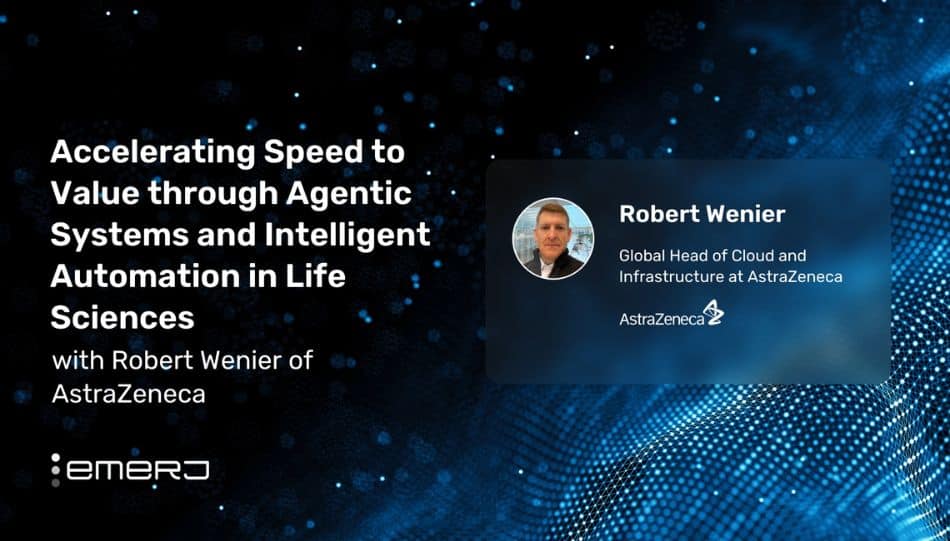
Robert Wenier, Global Head of Cloud and Infrastructure at AstraZeneca, has operated at the center of this challenge. In a recent conversation with Emerj’s Matthew DeMello, he makes the case for why life sciences organizations can no longer treat infrastructure as a back-office concern, and what it actually takes to build systems that keep pace with the AI they are meant to support.
This article examines how life sciences enterprises can accelerate speed‑to‑value by aligning AI, agentic systems, and infrastructure strategy across cloud and edge environments:
- Workload‑driven infrastructure placement: Aligning AI training, inferencing, and operational workloads to the appropriate layer of the cloud–edge continuum enables enterprises to improve performance, reduce latency, and control cost as AI adoption scales.
- Object storage as the AI‑ready data layer: Using object storage to manage unstructured and semi‑structured data provides organizations with the flexible foundation needed for generative and agentic systems to operate reliably across research and manufacturing environments.
- Adaptive architectures for continuous AI evolution: Designing infrastructure and governance models that can absorb rapid AI capability shifts — from SageMaker to generative AI and beyond — prevents multi‑year disruption and positions enterprises to capitalize on emerging automation opportunities.
Listen to the full episode below:
Episode: Accelerating Speed to Value through Agentic Systems and Intelligent Automation in Life Sciences – with Robert Wenier of AstraZeneca
Guest: Robert Wenier, Global Head of Cloud and Infrastructure at AstraZeneca
Expertise: AI Platforms & Industrialization, Cloud & Infrastructure Strategy, Enterprise Technology Transformation, Technology Governance in Regulated Industries
Brief Recognition: With more than a decade of experience leading large-scale enterprise technology transformations, Robert Wenier has built and operated global cloud, infrastructure, and AI platforms in highly regulated, mission-critical environments. Most recently, he served as Executive Director of Technology Platforms and AI Infrastructure at AstraZeneca, where he led a $900M+ global portfolio supporting 250,000+ employees and delivered enterprise AI factories, significant productivity gains, and large-scale cloud optimization. Prior to this, he was Chief Technologist for Cloud at Northrop Grumman, where he drove a $150M+ cloud strategy, migrated thousands of applications, and built enterprise-wide cloud capabilities.
Workload‑driven Infrastructure Placement
Robert makes the workload-placement question much more practical than a generic cloud-versus-edge debate. As he puts it, “If it’s synchronous, it needs to be in the edge. If it’s asynchronous, it can go to a hyperscaler.” In life sciences, that distinction matters because placement should follow execution needs, not organizational habit.
He makes the point concrete with the example of manufacturing. If a team has trained a model to detect a defect, Robert says, there is no reason to run that inference workload in the cloud if it can operate inside the manufacturing estate. Training and inference are different tasks, and they should not be treated as if they require the same environment.
That distinction also changes how leaders think about compute. Robert notes that inference does not require the same GPU depth as training, so executives should avoid overbuilding production infrastructure for workloads that do not need it. The speed-to-value gain comes from placing each workload where it performs best without adding avoidable cost or latency.
Object Storage as the AI‑ready Data Layer
Robert’s point about object storage is less about technology choice and more about clearing a path for modern AI to actually work inside a life sciences enterprise.
Organizations still carry decades of structured systems — relational databases, rigid schemas, carefully modeled warehouses — and those systems simply weren’t built for the kind of unstructured, high‑volume data that generative and agentic systems rely on.
Object storage changes the equation. It gives teams a place to store the messy, heterogeneous data generated by discovery and manufacturing every day — images, documents, instrument outputs, semi‑structured logs — without forcing it into a structure that limits how AI can use it later.
Robert captures this shift clearly:
“Object storage is really the foundational element of generative AI, they want the raw, dirty data, variables they can pull in, and then they’ll contextualize and organize it. We used to have to use non‑SQL databases and build ontological models. Now we just dump it in and let the model figure out how to organize it.”
- Robert Wenier, Global Head of Cloud and Infrastructure at AstraZeneca
For leaders, the implication is that if your data is locked in legacy formats, your AI strategy will always be constrained by the past. Object storage gives enterprises a way to modernize without ripping out every legacy system — a neutral layer that both discovery and manufacturing can feed into, and that AI systems can learn from without friction.
It’s not a storage upgrade. It’s the architectural foundation that determines whether generative and agentic systems can operate across the full life sciences value chain.
Adaptive Architectures for Continuous AI Evolution
Robert’s final theme is a warning to large enterprises: the pace of AI advancement is now faster than the pace of enterprise change. The organizations that fall behind aren’t the ones that choose the “wrong” cloud or the “wrong” model — they’re the ones whose infrastructure and governance models can’t absorb the next major capability shift without years of rework.
AstraZeneca’s own experience illustrates this. The team had just scaled up cloud‑based model development when SageMaker democratized AI workflows. Before they could fully stabilize that wave of adoption, generative AI arrived and reset expectations again. Each leap created new demand from scientists, new pressure on infrastructure, and new governance challenges.
Robert puts it bluntly:
“A large enterprise is like a huge oil tanker in the ocean. [They] don’t exactly turn on a dime.” Large enterprises run years behind because they’re optimizing risk, cost, and performance — while smaller players can jump on the next great thing as early adopters or fast followers.
– Robert Wenier, Global Head of Cloud and Infrastructure at AstraZeneca
Robert captures the dynamic plainly: “While we were trying to contain the enthusiasm, generative AI came out, and it’s reoccurred, and the next great leap will do the same thing.”
For enterprise leaders, the takeaway is not to chase every new capability, but to build an architecture that can withstand them. That means infrastructure that can flex between cloud and edge without replatforming, governance that can scale with new tools rather than constrain them, and operating models that anticipate rapid iteration rather than resist it.
Enterprises that design for adaptability — rather than stability alone — are the ones positioned to capitalize on each new wave of automation rather than be disrupted by it.