



Royal Bank of Canada (RBC), headquartered in Toronto, Ontario, is Canada’s largest bank and one of the world’s largest by market capitalization. Operating across 29 countries and employing over 98,000 employees as of 2024, the company reported an annual total revenue of $57 billion and a record net income of $16.2 billion, driven in part by the acquisition of HSBC Bank Canada and the strong performance of acquisitions in the UK and the EU.
RBC’s commitment to internal AI deployment is evident in RBC Borealis, a research institute within RBC that serves as the bank’s primary AI center of excellence.
The institute describes itself as performing fundamental and applied research in machine learning to advance the state-of-the-art in AI for financial services and beyond. Launched in 2016 and now boasting 950+ employees, the institute’s growth and extensive research output confirm the level to which RBC regards AI within its business strategy.
Further evidence of RBC’s commitment to AI is clear in its significant capital allocation — a 2025 “Investor Day” presentation notes the bank is currently investing over $5 billion in technology to accelerate innovation. This investment is tied to a bold, measurable financial outcome: RBC’s strategic AI ambition targets generating a substantial $700 million to $1 billion in enterprise value from AI by 2027.
The bank’s explicit focus demonstrates that AI is highly integrated into RBC’s corporate framework, where fundamental research must yield a clear, anticipated pathway to scale, monetization, and reduced risk.
This article examines two mature, internally deployed applications that illustrate AI’s central role in Royal Bank of Canada’s core operations:
- Leveraging AI and ML to adapt to evolving risk: Implementing federated machine learning methods for better pattern matching and the elimination of sensitive data exchange.
- Applying deep learning for optimized pricing strategies: Utilising deep reinforcement learning to provide greater control to traders while minimising slippage against industry benchmarks.
Leveraging AI and ML to Adapt to Evolving Risk
The financial sector faces enormous challenges as AI becomes more widespread. A recent study by the Ontario Securities Commission (OSC) found that AI-enhanced scams pose significantly greater risk, with controlled tests showing participants invested 22% more in AI-enhanced scams than in conventional scams.
For context, data from the Canadian Anti-Fraud Centre (CAFC) reveals that Canadians lost $638 million to fraud in 2024 alone. That number is expected to grow as AI technology becomes more widely adopted, leading to more sophisticated approaches. A blog post published by RBC warns that social engineering attacks and ever-more complex AI-powered scams are becoming even more believable and successful.
To address these challenges, RBC launched a fraud modernization initiative that is transitioning its defense systems from static rules to adaptive, real-time risk scoring engines powered by advanced AI and Machine Learning (ML).
According to a company press release, the foundational infrastructure was custom-built, enabling complex event processing and embedding behavior analytics and fraud prediction capabilities. The system leverages the bank’s massive data stream, analyzing roughly 11 trillion security events in 2024 alone, as reported in the Investor Day presentation.
A notable example of RBC’s approach to tackling fraud is a joint experiment with Vector Institute to address a new and growing threat to financial services: mule account fraud.
Mule account fraud occurs when criminals scam victims into allowing them to use their bank accounts, or when criminals open accounts using stolen identification documents. Because they often operate across multiple institutions to obfuscate their activities, the technique has proven particularly difficult to counter.
Fraud detection relies heavily on analyzing sensitive information, such as transaction data, device activity, and user behavior. The addition of AI increases the risk of violating privacy laws, as AI systems can collect excessive data, handle it in an insecure manner, or even misuse it.
As reported by Borealis AI, the joint approach to address mule account fraud leveraged advanced machine learning and federated learning. The federated technique allows multiple institutions to train models collaboratively without exchanging sensitive customer data, while still benefiting from patterns observed across multiple banks.
According to the report, the participating banks each train a local model on their own data, with only the learned model parameters being aggregated into a global model shared by all. The result is the detection of fraud patterns that may be invisible to any single institution.
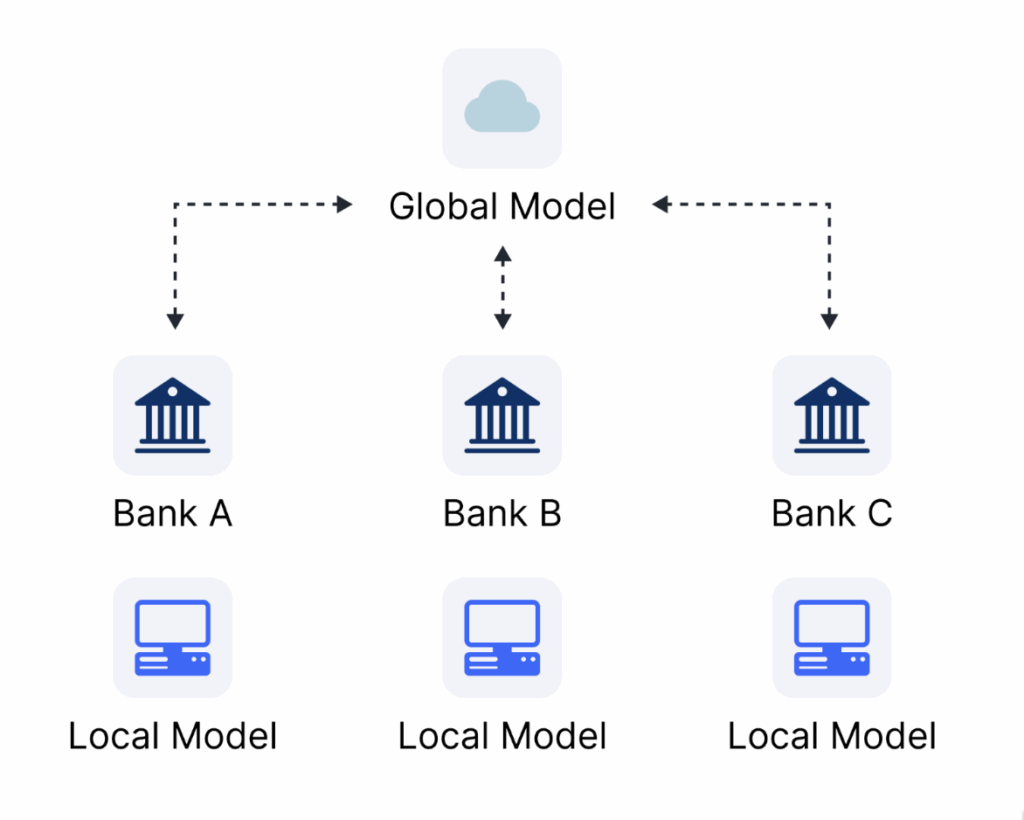
The results showed “notable improvements in performance metrics for all clients” and that shared learning across clients helped generalize better to fraud patterns.
Applying Deep Learning for Optimized Pricing Strategies
Across data-intensive industries, the speed at which information becomes actionable often defines competitive advantage. Yet in work environments that are becoming increasingly inundated with data, business demands are outpacing human capacity.
Microsoft’s 2025 Work Trend Index Annual Report reveals that the average employee is now interrupted 275 times per day by meetings, email, or chat, or once every two minutes during peak work hours.
In equity research, legal analysis, and other expert-driven domains, doing so only compounds the challenge of productivity when professionals still spend time extracting, formatting, and summarizing data before they can interpret it.
As information flows multiply across reports, transcripts, and real-time disclosures, manual synthesis becomes the constraint — not expertise. The result is a widening gap between data availability and decision readiness. For large enterprises competing on insight, this “time-to-insight gap” (referred to in the Microsoft report as a “capacity gap”) translates directly into opportunity cost: delayed analyses, slower client delivery, and reduced capacity for strategic thought.
In equity research, time is a competitive advantage. For RBC’s Capital Markets business, the challenge each earnings season is scale: analysts must publish client-facing updates across dozens of covered companies within hours of results being released.
The traditional workflow — reading press releases, extracting data, drafting commentary, formatting, and publishing — could take 45 minutes per company. Across hundreds of reports, the administrative load consumes a significant amount of analyst time, resulting in delayed insights reaching clients.
To address this bottleneck, RBC developed Aiden QuickTakes, an AI-driven system that automates the first draft of equity research notes. Integrated into analysts’ existing workflow, RBC claims its platform ingests a company’s earnings release, compares new figures with historical data, and produces a structured draft within minutes.
According to company product documentation, the analyst remains in the loop, reviewing the content for accuracy and adding contextual interpretation before publication — an approach we see across industries. The automation removes manual extraction and boilerplate writing while retaining human judgment for final approval.
Underpinning the system is a secure data architecture designed for accuracy and governance. RBC claims that, thanks to its partnership with the Databricks platform, the pipeline merges structured financial data with unstructured text in real-time, validating every figure before inclusion. Merging structured and unstructured data ensures generated drafts meet the precision standards of regulatory-compliant research, where numerical accuracy must be absolute.
The measurable impact has been notable. A company blog post by Bobby Grubert, Global Head of AI and Digital Innovation at RBC Capital Markets, reports a 20 to 60 percent reduction in turnaround time, cutting publication cycles to approximately 15 minutes per report, in contrast to the previous average of 45 minutes.
Across the research division, automation has reclaimed thousands of analyst hours annually, according to RBC, enabling staff to redirect their time to client interaction, thematic research, and expanded coverage.
Although not directly related to the QuickTakes application, the following discussion between RBC Capital Markets Executives provides further detail on the broader Aiden platform and its development, with the most relevant portion of the discussion starting at the 58-second mark:
Despite this, some level of understanding can be gleaned from the results shared in the bank’s Investor Day Presentation. Between 2019 and 2024, RBC increased its annual technology capital spending by 7%, while the revenue generated per dollar of technology capital invested improved by 15% — indicating a measurable uplift in commercial productivity relative to technology investment.
Reported at the end of Q3 2025, the business disclosed record net income of $5.4 billion, up 21% from the prior year.
While these results cannot directly be attributed to technology investments — and what percentage of these investments was explicitly made into AI has not been disclosed — new partnerships, along with their stated $5 billion investment into technology, indicate that the bank’s leaders see value in the continued deployment of AI projects throughout their value chain.