


The AI conversation has made it into the C-suite at large banks. Leaders from Citi to JP Morgan are considering how to respond to their competitors’ press releases and looking to craft winning AI strategies and adopt low-hanging fruit AI applications in their business.
They’re seriously thinking about AI in ways that will prove productive for the business in the coming three to five years. In other ways, not so much. Banking leaders are thinking about:
- Low-Hanging Fruit AI Applications
- AI as an Efficiency Driver
- Everyone is Doing AI
There is a lot that leaders at large banks are missing, and they’re falling for marketing and AI hype they should really avoid.
In this article, we outline three common themes in the AI thinking that we find among banking leaders in the United States and Europe, as well as some of the important points that they’re overlooking.
We discovered these themes as part of our AI Opportunity Landscape research in financial services, for which we interviewed over 40 AI-focused executives at top global banks and AI vendors in the financial services industry.
The goal of this article is to help banking leaders make better use of artificial intelligence in their business.
There are five key concepts that banking leaders are missing:
- Strategy
- Critical Capabilities
- Revenue and Business Transformation
- Hype and Deceptive Marketing
First, we break down how banking leaders are thinking about first AI project: low-hanging fruit.

Low-Hanging Fruit AI Applications
Banking leaders are often looking for small projects to start with when it comes to artificial intelligence applications. Starting small, in theory, makes sense. Banks want to make sure that an application can actually deliver value before pouring more resources into an artificial intelligence effort.
But it’s often very challenging to start small without a broader context of the goal you’re trying to achieve and the longer-term aims of AI within the business.
When it comes to finding AI opportunities within a business, ideally, a bank could begin with a broad map of all the different artificial intelligence opportunities for efficiency , revenue, and risk reduction that there are across the financial services industry. The bank could then find an overlap between these opportunity areas and the key differentiators at the bank.
The bank could then develop a level of confidence in the near- and long-term value of certain high ROI AI projects, allowing leadership to truly support those projects and carry them through to success.
The fact of the matter is leadership at most banks is not going to start with that broad of a context. Leadership is going to think about AI as if it’s IT and it can just be plugged in like any other software.
Often the reality is that innovation strategy leaders often within banking will have to start with smaller projects because they’re unable to get a bigger mandate from leadership at the company.
Starting with low-hanging fruit is a necessary frame of operating within an enterprise, but it’s not necessarily ideal.
What They’re Missing: Strategy
When a bank picks an initial project, a bank’s AI champion is often thinking about the results they can generate with AI in a particular area of the business. There are numerous AI projects where near-term ROI is possible.
Our AI opportunity landscape highlights some of these opportunities, but, in banking, they’re relatively rare. In addition, they’re not always indicative of the largest long-term opportunities.
Banking leaders need to ask themselves:
- How are we going to compete as a company in the future?
- What are our key differentiators?
- What are the AI capabilities that can enable us to maximize those differentiators?
Banking leaders should ask these questions at the outset of an AI project so that instead of looking for pockets of the business in which to deliver little value to prove that AI even has value, they look for areas of inevitable, longer-term AI value. These will be areas in which a bank can feel confident investing even if near-term ROI is a challenge.
A long-term AI strategy should at least be part of a bank’s consideration for picking initial AI projects, especially because it can be hard to predict the ROI of AI in the short term.
What They’re Missing: Critical Capabilities
Businesses also often overlook critical capabilities. AI adoption is a process. While enterprise leaders wish that they could simply pick a part of their business, apply AI there, and generate value, the adoption of artificial intelligence is actually much more complicated than that.
At Emerj, we operate on a framework of critical capabilities, prerequisites for artificial intelligence deployment. These include:
- A strong understanding of a company’s data and a data infrastructure that provides them with access to that data
- The establishment and function of cross-functional AI teams
- The AI understanding of executive leadership
In order to develop a “low-hanging fruit” project, banks need to build some level of these critical capabilities. Projects need to be measured not only in terms of how well they can deliver near term ROI (although that’s incredibly important). They also need to be chosen based on their ability to help a bank improve its critical capabilities.
It’s incredibly hard to deliver value to a small pocket of the business without building critical capabilities. Banks need to see these small low-hanging fruit projects as part of a process of building these critical capabilities among leadership.
While there is a much broader process that we use for matching these capabilities to an financial services company’s efforts, it’s important for leaders to consider some of them on their own and think through how to build them through initial AI projects.
AI as an Efficiency Driver in Banking
Efficiency is a real consideration in banking. Our AI Opportunity Landscape research shows that AI can deliver efficiency improvements in several banking processes, particularly risk-related processes like fraud detection and cybersecurity.
There are a great many ways that AI can help save costs. It’s an important lens to think through, but when it comes to the ROI of AI projects, banking leaders often overlook is revenue and business transformation.
What They’re Missing: Revenue and Business Transformation
Currently, banking leaders primarily think about AI as a way to automate process. But there are many ways to automate processes to reduce overhead, to reduce time to delivery, without leveraging AI.
AI should be seen as a new, broad approach to solving business problems that could apply to driving revenue and to transforming the nature of how a bank does business and delivers value to its customers.
For example, a bank may want to build an AI application for handling routine customer service inquiries or routing inquiries to the proper customer service team member.
Companies like Kasisto can potentially deliver value of that kind. This would drive efficiencies in the customer service department.
Below is an example of Kasisto’s KAI chatbot:
But banks could look at customer service applications as delivering revenue by improving upsell take rates.
For instance, an AI application that routes customer support tickets in and of itself could drive efficiencies, but it could route tickets to people trained to cross-sell and upsell customers into different products or direct them to a salesperson to handle their needs. This could generate more revenue for the business.
Similarly, customer service-related applications could also be thought of as preventing customer churn, thus having a positive impact on the top line.
There also exist AI applications for marketing and sales that cater to financials services companies. Although they are rare, they shouldn’t be entirely ignored.
One of the reasons that AI vendors in in the financial services industry that offer marketing and sales applications have raised relatively little money is because banks are looking to AI as a way to reduce risk and drive efficiencies.
They’re generally not looking to adopt AI for the sake of driving new revenue. But again, these are not opportunities that should be wholly ignored.
There are also AI applications for lending. While there are certainly opportunities to create efficiencies within lending, one of the largest long-term opportunities is offering lending products to a new cohort of customers who might not have lengthy credit histories.
These new markets are opening up not only with younger customers in the United States who might have less of a credit history, but also in developing countries. This is a revenue opportunity that is often overlooked in discussions about AI as it relates to lending.
While efficiencies have their limits, revenue opportunities are ultimately going to make the most impact in lending.
Everyone Is Doing AI
There is currently a perception among small and mid-sized banks that large banks are no longer using Excel sheets and older technology systems—that they are adopting artificial intelligence in all corners of the business.
Similarly, leaders at the top five US banks tend to think their competitors are farther ahead with AI than they actually are.
Put simply, there exists a perception in banking that everyone is doing AI. That isn’t the case.
Although this isn’t true, there will be an inevitable shift in the way that banks do business in response to AI. It is important to stay on top of these technologies. It’s important to track and understand what competitors are doing because artificial intelligence is going to inevitably change the nature of banking.
What They’re Missing: Hype and Deceptive Marketing
What banking leaders tends to overlook is hype and deceptive marketing. When banks pay attention to press releases from their competitors and pitches from vendors, they get a very biased view of where AI investments are going and how far along AI adoption actually is in key business areas.
What ends up happening is bankers tend to think that there is a lot more traction and ROI for AI applications that are customer-facing, and they tend to actually underestimate the amount that their competitors are investing in applications like cybersecurity, fraud, and compliance.
Banks aren’t often going to publicize their use of AI for these functions, but they are the functions into which most of the money is being channeled.
Our AI Opportunity Landscape research shows that over 50% of the AI products top 100 global banks say they’re adopting in press releases are for customer service; however, AI vendors offering customer service products have only raised a collective $158 million, 5.5% of the funds raised for AI in banking.
The opposite is true for fraud and cybersecurity. Approximately 10% of the AI product top 100 global banks say they’re adopting are for fraud and cybersecurity, but roughly 26% of the venture funding is in fraud and cybersecurity, the most of any area of the banking industry.
This is illustrated in the graph below:
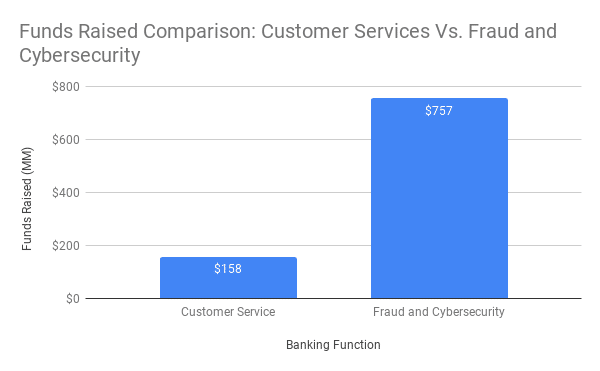
This discrepancy reveals that banks are keeping their work on AI-enabled fraud and cybersecurity systems quiet, most likely because they both don’t want their competitors to know which vendors they are working with and don’t want fraudsters to know which products they use to combat their fraud attempts.
Banking leaders aren’t going to know this if they stop their research and competitor press releases.
The consequences of simplistic research is dangerous. Banks miss out on most of the use-cases in which the value is actually being delivered. They miss out on risk-related applications that banks might not want to talk about, but where they actually are doubling down their investments and where a lot of the actual low-hanging fruit genuinely resides.
When it comes to assessing what their competitors are doing, banks are just skimming the surface. Competitive intelligence merits getting much deeper access to what the top banks are doing and what AI vendors in banking are offering.
Emerj for Banking Leaders
Banks use Emerj AI Opportunity Landscapes to pick first AI projects and, select credible AI vendors that are likely to deliver ROI, and steer their companies toward long-term AI transformation. Banking leaders work with Emerj to make informed decisions about artificial intelligence well into the future. Learn more about Emerj Research Services.