

Regulated industries are adopting AI from a position most technology buyers never face: zero tolerance for error. Financial services, legal, tax, and audit functions operate under a standard where partial accuracy is not a rounding error — it is a compliance failure with regulatory, financial, and reputational consequences.
The scale of what is at stake is already large before AI enters the picture. Research published by the National Bureau of Economic Research found that the average US firm spends between 1.3 and 3.3 percent of its total wage bill on regulatory compliance, a burden that has grown over time and varies sharply by industry and firm size.
Stanford researchers tested general-purpose language models against verifiable legal questions and found hallucination rates ranging from 58 to 88 percent, underscoring why off-the-shelf AI remains unfit for high-stakes legal and regulatory work without purpose-built safeguards.
Data handling compounds the accuracy problem. NIST’s AI Risk Management Framework names privacy concerns tied to the use of underlying data to train AI systems as a core risk category, alongside the security of a model’s training and output data.
For financial institutions, this translates into a hard requirement: vendors must prove that sensitive filings, tax records, and client data never become part of a model’s training corpus — a guarantee most commercial AI systems are not built to make.
These pressures mean institutions need AI that can meaningfully reduce the labor and cost of regulatory work without introducing the two failure modes—inaccuracy and data leakage—that this sector cannot tolerate.
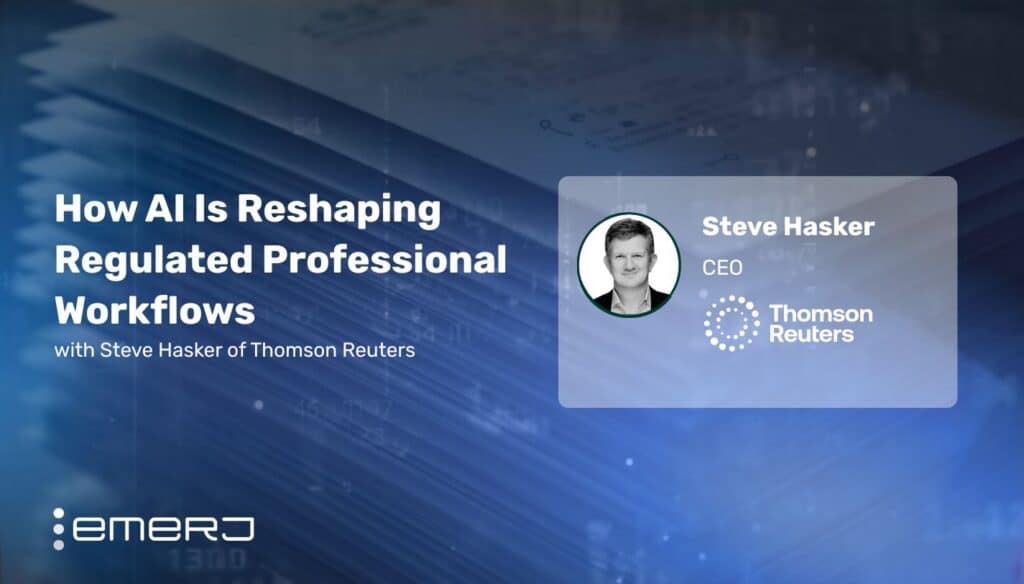
Daniel Faggella, Emerj CEO and Head of Research, hosted Steve Hasker, CEO at Thomson Reuters, on the AI in Financial Services Podcast to delve into how regulated institutions can safely adopt AI by meeting fiduciary‑grade accuracy requirements, protecting sensitive data, and preserving accountability for regulated decisions.
This article distills four insights on how fiduciary‑grade AI reshapes legal, tax, and regulatory decision‑making in financial services:
- Fiduciary‑grade accuracy requirements for regulated AI work: Legal, tax, audit, and regulatory functions require standards of correctness that make “mostly accurate” AI outputs insufficient for regulated use.
- Workflow automation for labor‑intensive regulatory processes: AI can reduce the burden of preparing, reviewing, and validating large‑scale regulatory filings while preserving professional accountability.
- Data‑protection guarantees for regulated AI adoption: Sensitive customer and institutional information must remain isolated from model training and protected from exposure in future outputs.
- Explicit sign‑off requirements for machine‑assisted decisions: Regulated outputs must be approved by the individuals who carry fiduciary and regulatory responsibility, even when AI accelerates the work leading up to those decisions.
Listen to the full episode below:
Episode: How AI Is Reshaping Regulated Professional Workflows – with Steve Hasker of Thomson Reuters
Guest: Steve Hasker, CEO at Thomson Reuters
Expertise: Executive Leadership, Business Strategy, Information Services, Digital Transformation
Brief Recognition: Steve Hasker is President and CEO of Thomson Reuters. Previously, he served as Senior Advisor at TPG, CEO of CAA Global, Global President and Chief Operating Officer at Nielsen, and spent more than a decade as a partner in McKinsey & Company’s Global Media, Entertainment and Information Practice. Hasker holds an MBA and a master’s degree in International Affairs from Columbia University.
Fiduciary‑Grade Accuracy Requirements for Regulated AI Work
Steve Hasker anchors the discussion on regulated functions operating under accuracy standards that general‑purpose AI systems are not designed to meet. Legal, tax, audit, and financial‑services teams work in environments where incorrect outputs are not operational nuisances — they are compliance failures with regulatory, financial, and reputational consequences.
This creates a threshold AI must meet before it can enter core workflows: correctness must match the expectations placed on licensed professionals.
The challenge is not simply reducing hallucinations; it is ensuring that machine‑generated work aligns with the standards governing regulated submissions. Hasker notes that these functions depend on precision, verifiability, and consistency — qualities that probabilistic models do not guarantee without purpose‑built safeguards. AI can accelerate analysis and drafting, but only if its outputs meet the same fiduciary expectations as human work.
Accuracy requirements also shape where AI can be deployed first. Tasks that involve structured documents, repeatable review steps, and well‑defined correctness criteria offer the clearest path to safe adoption. In these areas, AI can support professionals by reducing manual workload while still operating within the boundaries of regulated practice.
Accuracy considerations Hasker highlights:
- Professional‑grade correctness: Regulated functions require outputs that meet the standards licensed professionals are held to.
- Verifiable reasoning: Machine‑generated work must be traceable to authoritative sources that professionals can review and validate.
- Consistency across submissions: Outputs must align with regulatory expectations and support dependable professional review.
- Suitability for structured tasks: Document‑heavy, repeatable workflows offer the safest early applications.
To operationalize these accuracy requirements, institutions often need clarity on:
- Correctness thresholds: What level of accuracy is required before AI can enter a workflow.
- Verification steps: How machine‑generated work is checked against authoritative sources.
- Professional oversight requirements: Where human review is required before outputs can be used in regulated workflows.
- Eligible workflows: Which tasks are appropriate for AI support based on accuracy requirements.
These accuracy expectations form the baseline for regulated AI adoption — a standard that ensures machine‑generated work strengthens professional output rather than introducing new compliance risks.
Workflow Automation for Labor‑Intensive Regulatory Processes
When asked which professional workflows are most likely to change in the near term, Hasker points to regulatory filing preparation. He describes a process that consumes enormous amounts of professional time while carrying substantial legal and compliance risk. Financial institutions routinely manage millions of pages of filings, disclosures, audit inputs, and supporting documentation — much of it repetitive, accuracy‑sensitive, and essential for downstream decision‑making.
“Regulatory filing preparation consumes enormous professional time, carries significant compliance risk, and is built on authoritative content. Expert‑driven AI applications can automate much of the investigative burden, but final accountability remains with the professionals who sign off.”
- Steve Hasker, CEO at Thomson Reuters
As Hasker notes, “content and expert‑driven AI applications [will] fundamentally automate that process,” enabling institutions to shift professional time from document handling to higher‑value analysis. The accountability structure does not change — CFOs, general counsels, and other responsible parties still retain sign‑off responsibility — but the work leading up to that decision becomes significantly more efficient.
When evaluating AI for regulated workflows, several practical considerations emerge from Hasker’s perspective:
- Regulatory filings present a high‑value automation opportunity — institutions devote significant professional resources to producing and reviewing filing documentation.
- AI can reduce investigative and review burdens — systems can help audit inputs and identify areas requiring additional analysis before final submission.
- Authoritative content enables trusted automation — professionals can only rely on AI outputs when systems are trained on highly accurate content and expert knowledge.
- Professional accountability remains unchanged — designated leaders still sign off on filings, opinions, and submissions.
In Hasker’s framing, regulatory filing automation is one of the clearest near‑term opportunities for AI in compliance‑bound environments — not because it replaces experts, but because it reduces the manual load that precedes expert judgment.
Data‑Protection Guarantees for Regulated AI Adoption
Hasker argues that data protection is one of the primary conditions for AI adoption in financial services. While organizations want the productivity benefits of AI, they also need confidence that customer information, transaction data, and proprietary institutional knowledge will remain protected. In highly regulated environments, data leakage is not simply a technical concern — it represents a potentially existential risk to the institution.
Hasker emphasizes that regulated institutions need guarantees that customer information, transaction data, and proprietary knowledge will remain isolated from model outputs. He contrasts this requirement with AI development approaches that rely on user interactions to improve model performance over time — a pattern that creates unacceptable exposure in financial and legal environments, where any reuse of customer inputs can violate regulatory expectations.
Hasker summarizes the requirement plainly:
“Financial institutions need confidence that customer information, transaction data, and proprietary knowledge remain protected when using AI. The benefits of automation can only be realized when organizations are certain their data will not become part of future model outputs.”
- Steve Hasker, CEO at Thomson Reuters
Executives evaluating AI systems for regulated environments can anchor their expectations to the practical constraints Hasker highlights:
- Customer inputs should remain isolated from future model outputs — regulated institutions require assurance that proprietary information will not be reused elsewhere.
- Data‑leakage risks must be treated as business risks — exposure of customer records, transaction data, or institutional IP carries significant consequences.
- Security controls must withstand regulatory scrutiny — CISOs, CTOs, and legal leaders require detailed explanations before approving deployments.
- Transparency supports adoption — institutions gain confidence when vendors can clearly explain how systems handle sensitive information.
Data‑protection guarantees are not a technical preference; in Hasker’s point of view, they are the foundation that determines whether regulated institutions can adopt AI at all.
Explicit sign‑off requirements for machine‑assisted decisions
One of Hasker’s central themes is that regulated AI adoption ultimately comes down to responsibility. AI can accelerate preparation, analysis, and review, but regulated outputs still require a clearly accountable individual to approve the final result. Throughout the conversation, he emphasizes the roles of the General Counsel, CFO, CEO, and other senior leaders — not as symbolic signatories, but as the people who carry legal and fiduciary responsibility for the work.
Hasker argues that AI will not remove this responsibility; instead, it will make accountability more explicit. Institutions must determine which tasks can be supported by machines and which decisions still require human judgment from licensed professionals or senior executives. In regulated environments, that distinction is essential because responsibility for filings, legal opinions, and financial submissions cannot be delegated to a model.
Looking across Hasker’s view of regulated AI adoption, institutions need to formalize the boundaries that keep accountability intact:
- Explicit sign‑off responsibilities — identify where General Counsel, CFO, or executive approval remains mandatory.
- Machine‑assistance boundaries — distinguish between work AI can accelerate and decisions requiring human judgment.
- Professional accountability structures — maintain clear ownership of filings, opinions, and regulatory submissions.
- Review requirements for regulated outputs — ensure AI‑generated work enters existing approval processes before final release.
In Hasker’s framing, AI changes how regulated work is prepared — but it does not change who is responsible for the final decision.