

This article is sponsored by Optilogic and was written, edited, and published in alignment with our Emerj sponsored content guidelines. Learn more about our thought leadership and content creation services on our Emerj Media Services page.
Enterprise supply chains are entering a phase where traditional planning models no longer protect the business.
As forecasting and optimization become standard features across nearly every platform, MIT Sloan Management Review argues that AI’s edge is structurally temporary, since algorithms, hardware, and talent are all commoditizing.
Meanwhile, the World Economic Forum found that even after four years of unprecedented disruption, more than 40% of organizations still report limited or no visibility into Tier 1 supplier performance — evidence that automation has outpaced insight.
Design, not planning, is emerging as the real competitive battleground. MIT Sloan Management Review and Tata Consultancy Services concluded that competitive advantage now depends on how well organizations architect the decision environment itself, not on the decisions AI generates within it. Most enterprises remain unequipped for that shift.
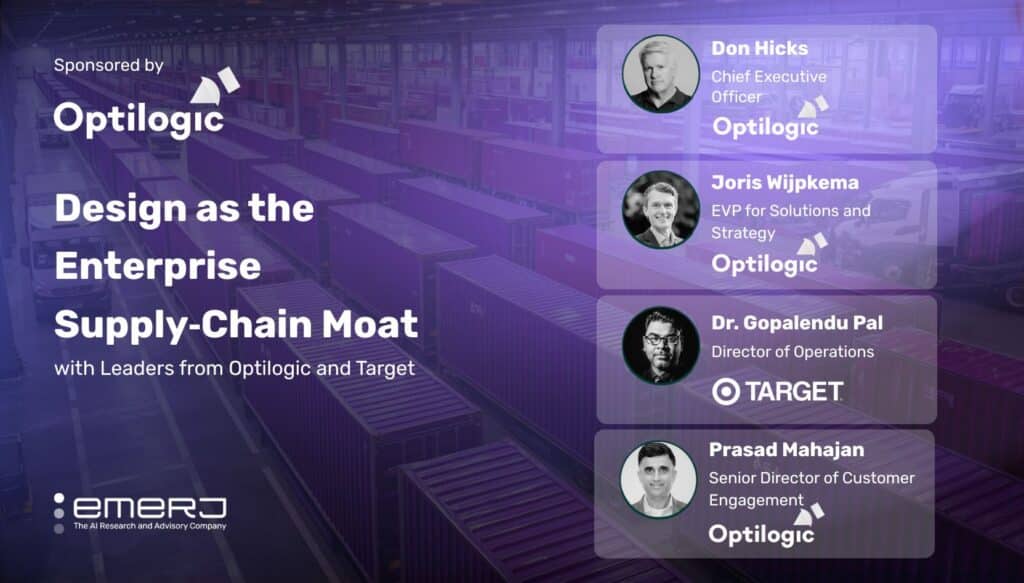
In a recent series on the AI in Business Podcast, Emerj brought together four leaders to examine how enterprises can rebuild supply‑chain decision‑making for a world where volatility is constant, disruptions compound, and traditional planning models no longer keep pace. Guests included Don Hicks, Chief Executive Officer at Optilogic; Joris Wijpkema, Executive Vice President for Solutions and Strategy at Optilogic; Prasad Mahajan, Senior Director of Customer Engagement at Optilogic; and Dr. Gopalendu Pal, Director of Operations at Target.
This article distills three insights on how scenario‑driven modeling strengthens supply‑chain decision‑making under volatility:
- Scenario‑driven network modeling for strategic flexibility: Modeling multiple future network configurations gives leaders clear options for how to pivot operations as conditions change, revealing the cost, risk, and resilience implications of each path.
- AI‑accelerated scenario analysis for proactive risk management: Running thousands of forward‑looking scenarios exposes hidden vulnerabilities and tradeoffs, enabling teams to make structural decisions before disruptions escalate into operational or financial impact.
- Unified design environments for cross‑functional alignment: Integrating modeling, planning, and financial impact into a single environment enables organizations to align operations, finance, and commercial teams around shared future‑state decisions rather than siloed historical metrics.
Listen to the full episodes below:
Episode 1: Why Supply Chain Design Becomes the Differentiator as AI Automates Planning – with Don Hicks of Optilogic
Guest: Don Hicks, Chief Executive Officer at Optilogic
Expertise: Supply Chain Technology, AI & Optimization, Enterprise Software, Business Strategy
Brief Recognition: Don is a technology entrepreneur and business executive with decades of experience building enterprise software companies focused on supply chain optimization and decision intelligence. He is the Founder and CEO of Optilogic, where he leads the development of supply chain design and optimization technologies. Previously, Don founded and served as President and CEO of LLamasoft, growing it into a leading supply chain software company that was acquired for $1.5 billion. He has also served as CEO of Saganworks and Managing Director of Multiverse Investments, supporting technology ventures and entrepreneurs. Donald graduated from the United States Military Academy at West Point, where he earned a degree in Systems Engineering, and later earned an MBA from the University of Michigan Ross School of Business.
Episode 2: Fixing the Decision Speed Gap in Modern Supply Chains – with Joris Wijpkema of Optilogic
Guest: Joris Wijpkema, EVP for Solutions and Strategy at Optilogic
Expertise: Supply Chain Strategy, Supply Chain Network Design, Operations Transformation, AI & Optimization
Brief Recognition: Joris is a supply chain and operations executive with more than 20 years of experience helping global organizations optimize manufacturing and supply chain performance. He currently serves as Executive Vice President of Solutions & Strategy at Optilogic, where he leads the company’s solutions organization, professional services, and deployment strategy for AI, optimization, and supply chain design technologies. Prior to joining Optilogic, Joris spent more than two decades at McKinsey & Company, where he became a Partner in the Manufacturing & Supply Chain practice, co-founded McKinsey’s Next Generation Operational Excellence service line, and built the Solutions organization for the firm’s Manufacturing & Supply Chain practice. He holds an MBA from Northwestern University’s Kellogg School of Management.
Episode 3: Closing the Decision Gap in Volatile Supply Chains – with Prasad Mahajan of Optilogic and Dr. Gopalendu Pal of Target
Guest: Dr. Gopalendu Pal, Director of Operations at Target
Expertise: Operations Leadership, Digital Transformation, Manufacturing Operations, Industrial Automation
Brief Recognition: Dr. Gopalendu Pal is Director of Operations at Target, where he leads large-scale fulfillment operations and operational transformation initiatives. Previously, he was Executive Director of Global Manufacturing Operations at Siemens Digital Industries Software, overseeing global manufacturing programs and digital transformation efforts for organizations including BMW, Nissan, GM, and Boeing. He also serves as Managing Partner at Nova Cygnus Advisory, advising organizations on operations, technology, and transformation strategy. Dr. Pal holds a Ph.D. in Computational Science from Penn State University and an MBA from the Texas McCombs School of Business.
Guest: Prasad Mahajan, Senior Director of Customer Engagement at Optilogic
Expertise: Supply Chain Network Optimization, Logistics Engineering, Supply Chain Design, Transportation Strategy
Brief Recognition: Prasad Mahajan is Senior Director of Customer Engagement at Optilogic. Previously, he spent more than two decades at Uber Freight, Transplace, and Ryan Transportation, where he led supply chain design, logistics engineering, and transportation optimization initiatives for enterprise customers including Nike, Mars, Eaton, BASF, AutoZone, Clorox, and Del Monte Foods. He also helped build and scale consulting practices in supply chain design and transportation assessments and maintained a long-standing strategic partnership with LLamasoft (now part of Coupa). Mahajan holds an MBA in Finance & Strategy from Southern Methodist University, an M.S. in Industrial Engineering from Oklahoma State University, and is APICS Certified in Supply Chain (CSCP).
Scenario‑Driven Network Modeling for Strategic Flexibility
Don Hicks opens the series with a disruptive observation: most organizations still make network decisions inside a structure built years ago — fixed supplier mixes, static lead‑time assumptions, and business rules no one has revisited. Flexibility begins by challenging these inherited constraints and designing multiple viable futures instead of optimizing a single historical plan. Hicks frames the problem:
“When we talk about planning, we’re talking about running your current supply chain the way it is structured today and making the best decisions within those constraints. Design means taking a step back and asking what supply chain you could have in the future if you changed suppliers, changed business rules, removed constraints, or reconfigured the network. Planning operates within the boundaries of your current network; design unlocks the network into something that will be easier to plan and a better fit for the environment.”
— Don Hicks, Chief Executive Officer at Optilogic
Joris Wijpkema expands this by showing how scenario‑driven modeling replaces reactive, war‑room decision‑making with genuine optionality. Historically, teams could evaluate only a handful of scenarios, which forced them to react slowly and often incorrectly as conditions shifted.
Modern modeling environments allow organizations to explore a wide range of future configurations across demand, supply, routing, inventory, and go‑to‑market strategies. Flexibility, in his framing, is created by understanding your choices before you need them.
Prasad Mahajan adds the operational dimension, noting that flexibility is not an abstract strategic concept — it is the ability to pivot quickly when planning horizons reset. That requires unified data, challenged assumptions, and visibility into cross‑functional tradeoffs. In his view, flexibility is preparedness: having alternative suppliers, alternative configurations, and alternative decisions already modeled so teams can act without hesitation:
“Volatility is different from disruption because there is no new normal to recalibrate around. Prices go up, then down. Tariffs rise, then fall. Planning horizons keep resetting. The companies that respond best are the ones that have already prepared alternative suppliers, alternative configurations, and alternative responses before volatility hits.”
— Prasad Mahajan, Senior Director of Customer Engagement, Optilogic
Dr. Gopalendu Pal reinforces that flexibility depends on organizational simplicity. Complex SOPs and fragmented KPIs slow teams down even when good options exist. Simplifying processes and aligning metrics across functions ensures that modeled alternatives can be executed quickly when conditions shift. His emphasis is that flexibility is only valuable if the organization can act on it.
What emerges across the series is a set of practices that strengthen strategic flexibility — not by predicting the future, but by designing multiple futures in advance:
- Model multiple future configurations instead of optimizing a single inherited plan.
- Challenge legacy constraints and business rules that limit future‑state options.
- Unify demand, inventory, and supplier‑capacity data to ensure modeled alternatives are grounded in reality.
- Simplify decision pathways so teams can act quickly when conditions shift.
- Break siloed KPIs that push functions toward conflicting decisions.
- Use humans‑in‑the‑loop to interpret scenario tradeoffs and ensure decisions align with strategic intent.
These insights give leaders a mandate to build a decision environment where multiple futures are always visible, assumptions are never static, and teams can pivot with confidence rather than react under pressure.
AI‑Accelerated Scenario Analysis for Proactive Risk Management
Across the conversations, the guests emphasize that AI’s most important contribution to supply‑chain decision‑making is risk visibility — the ability to see how disruptions propagate through a network long before they materialize.
Traditional planning tools optimize the present, but they cannot reveal failure modes, stress points, or non‑obvious interactions that determine whether a network bends or breaks under pressure. AI‑accelerated scenario analysis fills that gap by illuminating vulnerabilities that were previously invisible.
Prasad Mahajan explains that risk rarely arrives as a single shock. It emerges from interactions — supplier dependencies that collapse amid geopolitical shifts, inventory policies that fail at demand cliffs, routing strategies that become cost‑prohibitive amid regulatory changes. AI helps teams understand these interactions by generating variations of supplier configurations, routing paths, and inventory strategies that expose where assumptions fail. Risk management begins with understanding how your network behaves under stress, not how it performs under plan.
Joris Wijpkema reinforces the idea that the breakthrough is not about running “more scenarios,” but about running the right scenarios — the ones humans would never think to test. AI can surface edge‑case conditions such as tariff shocks, supplier insolvency, sudden demand cliffs, or regulatory changes that invalidate current routing strategies. These are not flexibility exercises; they are stress tests that reveal structural vulnerabilities and the tradeoffs leaders must confront long before a disruption materializes.
His insight captures the shift:
“Most organizations still go into crisis mode when disruptions happen. They set up a war room, gather analysts, pull data into spreadsheets, and work through the problem manually. Organizations that build digital models of their supply chains can do something different: they can quickly evaluate hundreds or thousands of response options, align teams around the best path forward, and respond faster than competitors.”
— Joris Wijpkema, EVP for Solutions and Strategy at Optilogic
Dr. Gopalendu Pal adds that risk compounds across layers of the business. AI can surface these compounding effects, but organizations must simplify decision pathways so insights can be acted on quickly. He suggests that AI can illuminate risk, but only operational discipline can neutralize it.
Don ties this directly to the design doctrine. AI accelerates the generation of risk‑focused scenarios, but it cannot compensate for outdated constraints. Leaders must use AI to test those constraints, expose where they fail, and redesign the network accordingly. This is where the “third twin” becomes essential — a design sandbox where worst‑case conditions can be explored safely, without impacting the live network.
The series exposes a set of mechanisms for seeing risk before it becomes disruption:
- Identify structural failure modes by testing supplier, routing, and inventory assumptions under stress.
- Reveal compounding risk interactions across demand variability, geopolitical shifts, regulatory changes, and supplier constraints.
- Surface non‑obvious tradeoffs that determine whether a network prioritizes cost, service, or resilience under pressure.
- Generate edge‑case conditions executives would never manually construct — tariff shocks, supplier failures, regulatory shifts.
- Pre‑decide responses to high‑probability disruptions so teams act immediately when triggers appear.
- Use AI to test inherited constraints and identify where outdated assumptions create hidden exposure.
- Run continuous stress testing to detect vulnerabilities before they materialize.
These mechanisms shift risk management from episodic analysis to structural foresight — giving leaders the ability to see vulnerabilities early, understand their implications, and make decisions before disruptions turn into losses.
Unified Design Environments for Cross‑Functional Alignment
Across the series, every guest pointed to the same structural issue: planning, operations, finance, and commercial teams are all optimizing different objectives using different data.
Planning optimizes execution. Finance optimizes cost. Commercial teams optimize service. None of them are working from the same model of the future, which means even good decisions collide with each other.
Joris Wijpkema notes that planning systems were designed to run today’s network, not evaluate tomorrow’s. When design work happens in spreadsheets or isolated tools, the insights never reach the teams responsible for acting on them. A modeled routing change never reaches the transportation layer. A modeled supplier strategy never reaches procurement. The organization isn’t misaligned because people disagree — it’s misaligned because they’re looking at different versions of reality.
In his conversation with Dr. Pal, Prasad Mahajan highlights a second barrier: teams often agree on the problem but disagree on the data. Forecasts, supplier‑capacity assumptions, inventory policies, and cost models live in different systems with different owners. Under volatility, this fragmentation becomes a decision‑speed tax. Leaders cannot act quickly if every function must reconcile its own version of the truth before taking action.
Misalignment isn’t just operational — it’s cultural, according to Dr. Pal. KPIs push functions toward conflicting decisions. A transportation team that measures only cost will reject a routing change that improves service. A finance team measured only on margin will reject a supplier‑diversification strategy that reduces risk. A planning team that measures only forecast accuracy will reject a design alternative that improves agility. Without shared metrics tied to future‑state outcomes, resilience dies in committee:
“Before even thinking about AI, organizations should examine how they operate today. AI is a fantastic hammer, but it’s still a hammer. You need the right data, the right processes, and people who understand how to use the tool. Simplification wins because a process that people can understand and execute consistently scales much more effectively than a complex one.”
— Dr. Gopalendu Pal, Director of Operations, Target
Don Hicks ties these threads together: if planning and design must operate in parallel, then the organization must operate in parallel as well. A unified design environment — one model, one data foundation, one set of assumptions — becomes the mechanism that aligns planning, operations, finance, and commercial teams around future‑state decisions rather than historical performance.
Alignment doesn’t show up as a workflow diagram — it shows up in how teams make decisions:
- Finance evaluates cost implications of a modeled network change.
- Operations evaluates service impact.
- Planning evaluates feasibility.
- Commercial teams evaluate customer implications.
Because everyone is looking at the same model, the conversation shifts from “whose data is right?” to “which future do we choose?” That is the organizational unlock.
These themes surface repeatedly across all three episodes:
- Consolidate the data foundations that feed design and planning so teams stop reconciling conflicting inputs.
- Replace siloed KPIs with shared metrics tied to future‑state outcomes, not historical performance.
- Move design work out of spreadsheets and into environments where planning, finance, and operations can interrogate the same assumptions.
- Establish decision pathways that allow modeled alternatives to be evaluated quickly rather than routed through sequential approvals.
- Ensure planning systems can consume design outputs so future‑state decisions flow directly into execution.
Resilience isn’t created by better planning or better design — it’s created when both functions operate from the same future‑state model. When organizations model feeds planning, planning feeds finance, and finance feeds commercial strategy, they stop reacting in fragments and start acting as a single system.