

This article is sponsored by Dialpad and was written, edited, and published in alignment with our Emerj sponsored content guidelines. Learn more about our thought leadership and content creation services on our Emerj Media Services page.
Agentic AI is becoming the defining capability in modern customer service enterprises, which are under increasing pressure to fix a problem that has been growing for decades: large, expensive, and structurally inefficient customer service operations.
The scale of that problem is significant. The U.S. Government Accountability Office reports that federal agencies obligated nearly $4 billion on call center operations over a five-year period, while broader telecommunications infrastructure supporting customer interactions exceeded $30 billion. At the same time, real-world demand continues to strain these systems: public-sector data shows that nearly 10 million customer service calls were placed in a single program cycle, with wait times often stretching to an hour or more.
Adoption has outpaced execution. The Stanford Human-Centered AI Institute reports that generative AI reached roughly 53% adoption across the population within three years — faster than the PC or the internet — yet most organizations still lack the workflow architecture required to operationalize AI at scale.
At the same time, reliability constraints remain unresolved. Stanford researchers find that even domain-specific AI systems can hallucinate between 17% and 33% of the time, underscoring the risks of deploying AI in high-stakes, regulated workflows.
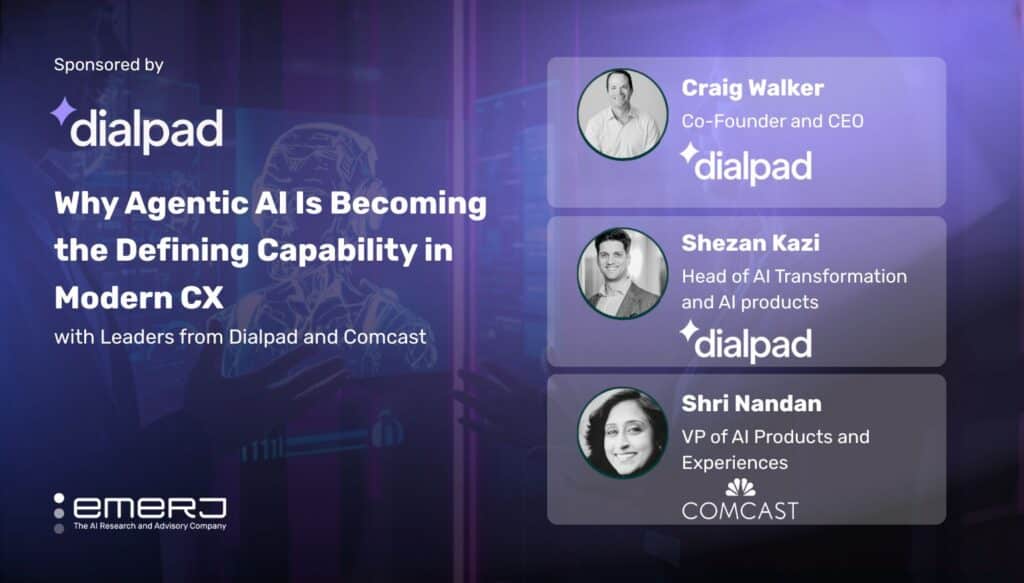
Emerj recently hosted Craig Walker, Co-Founder and CEO, Dialpad., Shezan Kazi, Head of AI Transformation and AI products at Dialpad, and Shri Nandan, VP of AI Products and Experiences at Comcast to unpack the system‑level mechanics that determine where agentic AI creates real operational value — from discovery and triage to integration and regulated‑workflow execution.
This article examines three insights that clarify why agentic AI is becoming the defining capability in modern customer service, particularly in regulated industries where accuracy, trust, and integration determine business outcomes.
- Conversation data as the source of high‑value automation: Large‑scale analysis of historical interactions reveals repeatable, compliance‑sensitive workflows where agentic systems can deliver immediate ROI by replacing guesswork with evidence.
- AI‑led triage as the catalyst for human augmentation: Placing agentic systems at the front of customer interactions removes remedial tasks from human agents, enabling faster resolutions and higher‑quality work while preserving human judgment for ambiguous or high‑stakes cases.
- Integrated platforms as the antidote to fragmented CX: Unified systems eliminate re‑verification, repeated explanations, and broken handoffs, allowing agentic AI, analytics, and human agents to operate in one continuous loop that improves customer satisfaction and operational efficiency.
- Workflow redesign as the unlock for vertical‑specific accuracy: Rebuilding processes so AI operates inside the live workflow — enriched with domain‑specific models — produces the accuracy, empathy, and compliance required for regulated environments to adopt agentic automation at scale.
Listen to the Episodes below:
Episode: Operationalizing Customer Service at Scale with Outcome-Driven Agentic AI – with Craig Walker of Dialpad
Guest: Craig Walker,Co-Founder and CEO, Dialpad
Expertise: Artificial Intelligence, Enterprise Communications, Product Strategy, SaaS & Cloud Technology
Brief Recognition: Craig Walker is a technology entrepreneur and executive with extensive experience building communications platforms and AI-powered software products. He is the Founder and CEO of Dialpad, an AI-powered communications and customer intelligence platform serving businesses globally. Prior to Dialpad, Craig founded GrandCentral Communications, a communications startup acquired by Google that became the foundation for Google Voice, where he later led product strategy and execution for Google Voice and Google Talk. He also served as an Entrepreneur-in-Residence at Google Ventures and previously founded and led Dialpad Communications, an early internet telephony company. Craig holds a JD from the University of California, Berkeley School of Law and an MBA in Finance from Georgetown University.
Episode: Scaling Customer Experience with Operationalized Agentic AI – with Shezan Kazi of Dialpad
Guest: Shezan Kazi, Head of AI Transformation and AI products at Dialpad
Expertise: AI Product Strategy, AI Transformation, Customer Experience Technology, Product Management
Brief Recognition: Shezan Kazi is an AI product and strategy leader focused on applying artificial intelligence to customer experience and business operations. He currently serves as VP of AI Products at Dialpad, where he leads the development of AI-powered products and agentic AI capabilities for customer experience and support. Previously, Shezan led AI strategy and transformation initiatives at Randstad as Head of AI Strategy, Global IT, focusing on AI adoption across client, employee, and business functions. He has also held leadership roles in technology recruitment and engineering talent organizations, including Head of Perm Engineering at GULP, where he specialized in embedded systems and technical engineering talent.
Episode: AI-Empowered Customer Service, From Hype to Scalable Operations – with Shri Nandan of Comcast
Guest: Shri Nandan, VP of AI Products and Experiences at Comcast
Expertise: Artificial Intelligence, Product Strategy, Customer Experience, Digital Transformation
Brief Recognition: Shri Nandan is a technology and product executive with more than 20 years of experience leading digital transformation, AI initiatives, and customer experience strategies across telecommunications, healthcare, financial services, and technology organizations. She currently serves as VP of AI Products and Experiences at Comcast, where she leads product, technology, and customer experience strategy within the Global Technology organization, including AI adoption, platform development, and cross-functional teams spanning product, engineering, data science, and analytics. Previously, Shri served as VP of Digital Products at Momentum Financial Services Group, where she led digital product modernization and omnichannel growth initiatives. She has also held digital strategy and experience leadership roles at Main Line Health and the Produce Marketing Association. Shri holds a Master’s degree in Computer Science from Mississippi State University.
Conversation Data as the Real Map of Automation Value
Enterprises begin their automation journey with a confident picture of where customer friction lives — and conversation data immediately proves them wrong. Craig Walker argues that leaders routinely misjudge their own workflows because they rely on intuition rather than evidence. Six months of historical interactions reveal patterns executives never anticipate: unexpected spikes in frustration, workflows that repeat far more often than assumed, and issues that dominate volume despite never appearing on leadership’s “top problems” list.
Shezan Kazi notes that this process routinely overturns enterprise intuition. CX leaders often request automation for password resets, flight changes, or lead qualification — until the data shows those aren’t the real drivers of volume or friction. The highest‑impact workflows are frequently unrelated to what leaders believed mattered.
The interaction data often reveals a completely different reality:
“When we look at six months of past conversations, we can see exactly which problems weren’t resolved and where customer frustration consistently spiked. Those patterns almost never match the list of issues leaders walk in assuming are their biggest pain points. In one case, a travel company expected flight changes to dominate their volume, but the data showed their young customers were mostly calling about something as simple as how to do their laundry.”
— Shezan Kazi, Head of AI Transformation and AI products at Dialpad
Shri Nandan adds that enterprises underestimate the operational complexity hidden inside their interactions. Only a full-spectrum view — across channels, customer types, and issue categories — reveals where automation can be deployed accurately, especially in regulated environments where precision is non‑negotiable.
The result is a clear diagnostic: interaction data, not executive intuition, determines where agentic AI can create real operational value. Discovery is not a preliminary step — it is the foundation of the entire automation loop.
AI‑Led Triage as the Catalyst for Human Augmentation
Once interaction data exposes where friction actually lives, the next challenge becomes executing those insights in real time. AI‑led triage is the mechanism that turns discovery into action — not by replacing agents, but by deciding how each interaction should unfold.
Shri Nandan argues that triage begins with AI taking the first pass: capturing identity, detecting intent, and resolving deterministic tasks immediately. For him, triage is fundamentally a compliance safeguard — ambiguity, noise, or regulatory sensitivity must trigger a handoff to a human while preserving full context.
Craig Walker sees a different benefit in the same structure. He frames triage as a way to elevate human work: when AI handles verification steps and repetitive questions, agents can focus on complex problem‑solving, empathy, and escalation management. The human role becomes concentrated on nuance rather than routine.
Shezan Kazi introduces a third angle: triage as a control system. He describes how Dialpad uses confidence scoring to determine whether the AI should continue or escalate. Deterministic tasks are resolved instantly; ambiguous ones route to humans. The system behaves like a routing engine — not a conversational interface.
Triage only works when the system preserves context end‑to‑end:
“If the platform isn’t unified, the customer ends up repeating themselves every time the interaction moves between systems. The agent then has to rebuild context from scratch, which breaks the entire augmentation model. AI can’t meaningfully support anyone in that environment, because it never sees the full interaction loop the way a human would.”
— Shri Nandan, VP of AI Products and Experiences at Comcast
In practice, triage unfolds in sequence: the AI captures identity and intent, resolves deterministic issues, and then — when ambiguity or compliance risk arises — hands off the interaction with full context intact. This is how discovery becomes executable inside the live workflow.
Integrated Platforms as the Antidote to Fragmented CX
Triage can only function if the underlying architecture preserves context. This is where fragmentation becomes a structural failure rather than a tooling inconvenience. Shezan Kazi points out that when chatbots, IVRs, CRMs, and analytics tools operate as separate systems, the interaction becomes disjointed. AI loses grounding. Agents lose context. Customers repeat themselves. Every handoff becomes a reset.
Craig Walker argues that unified platforms fundamentally change system behavior. When every part of the workflow runs within a single environment, the AI can track context across turns, maintain grounding, and decide whether to resolve or escalate. Human agents receive the full interaction history instead of reconstructing it. Architecture becomes an enabler of triage, not an afterthought.
Unified architecture eliminates the reset effect:
“When you stitch together five different systems, the customer effectively starts over every time the conversation shifts. The AI loses grounding, the agent loses context, and the entire workflow becomes fragmented. A unified platform creates one continuous loop where every part of the system sees the same interaction history, which is the only way AI can behave reliably.”
—Co-Founder and CEO, Dialpad.
Shri Nandan adds that integrated platforms also enable compliance, auditability, and consistent decisioning — especially in regulated industries where accuracy is essential. When AI sees the entire interaction loop, it can act with precision rather than guessing.
Three design principles emerge:
- Context continuity: Every system sees the same interaction history.
- Unified decisioning: Routing, triage, and automation draw on a single source of truth.
- Seamless escalation: AI hands off to humans without losing state.
Integration isn’t a CX preference — it’s the architectural requirement that makes triage viable at scale.
Workflow Redesign as the Unlock for Vertical‑Specific Accuracy
Integrated platforms solve continuity, but regulated industries introduce a different constraint: workflows that machines cannot yet execute. Vertical accuracy comes from AI performing each step of the regulated workflow with embedded domain logic — not generating responses around it.
Shri Nandan argues that industries such as healthcare, insurance, and financial services rely on processes characterized by implicit rules, compliance gates, and historical decision patterns. These workflows only make sense when executed in sequence. When AI is bolted onto legacy flows, it behaves like an observer rather than an operator.
Craig Walker describes how Dialpad addresses this by decomposing regulated workflows into machine‑executable units. Eligibility checks, formulary rules, credential validation, policy lookups, case‑note retrieval — each becomes a discrete action the AI can perform deterministically. The workflow shifts from human interpretation to step‑level execution.
Shezan Kazi adds that domain‑specific models behave correctly only when embedded directly into this redesigned workflow. Vertical models trained on regulatory nuance and historical decisions act like practitioners when grounded in the operational context.
Vertical accuracy requires AI to execute the workflow itself, step by step:
“You get accuracy in regulated workflows only when the AI is performing the actual operational steps rather than guessing at them. The domain logic has to be present at the exact moment each action occurs, not bolted on afterward. When the workflow is rebuilt into machine‑executable units, the AI can behave with the same precision a trained specialist would.”
— Shezan Kazi, Co-Founder and CEO, Dialpad.
Regulated environments impose three constraints on agentic automation:
- Machine‑executable steps: Each action must be deterministic and auditable.
- Domain‑grounded models: Regulatory nuance and terminology must be embedded at the step level.
- Compliance gates: The workflow must include explicit checkpoints where AI either meets accuracy thresholds or escalates.
In this sense, agentic AI doesn’t fail because models fall short — it fails because the enterprise never converted its operations into something a machine can actually execute.