

This article is sponsored by Salesforce and was written, edited, and published in alignment with our Emerj sponsored content guidelines. Learn more about our thought leadership and content creation services on our Emerj Media Services page.
Customer-facing organizations now face a widening capacity gap driven by escalating multi‑channel demand and the constraints of human-only workflows and unsynthesized data.
The U.S. Bureau of Labor Statistics projects that employment of customer service representatives will decline by 5% through 2034, even as inquiry volume continues to climb — a signal that automation, not hiring, is expected to fill the gap.
On the sales side, a landmark Harvard Business Review study of 2,241 U.S. firms found the average company took 42 hours to respond to a new lead, and organizations that waited 24 hours or longer were more than 60 times less likely to qualify that lead than those responding within the first hour. Although published in 2011, the study remains one of the most widely cited examinations of speed-to-lead because it quantified how rapidly qualification rates deteriorate with increasing response times.
Consumers are already responding to the result: Pew Research Center finds that while roughly half of U.S. adults now use AI chatbots regularly, only 29% of those users trust the information the tools give them.
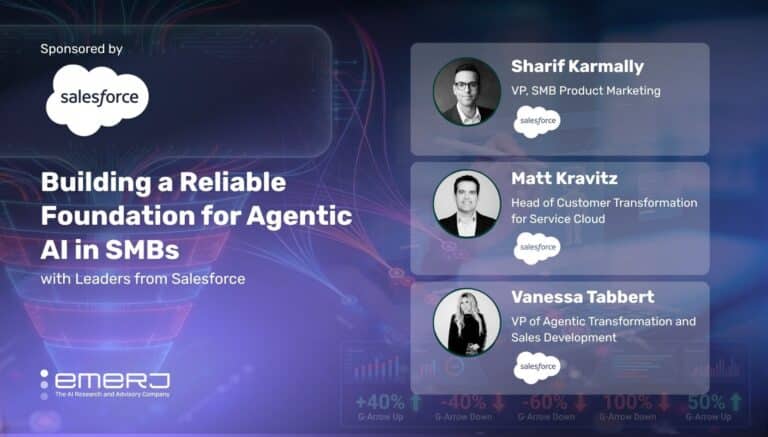
Emerj recently hosted conversations with leaders at Salesforce, Sharif Karmally, VP, SMB Product Marketing, Matt Kravitz, Head of Customer Transformation for Service Cloud, and Vanessa Tabbert, VP of Agentic Transformation and Sales Development, in a series on agentic readiness for SMBs and building the data, workflows, and guardrails for AI‑driven growth.
This article examines the core insights SMB leaders need to adopt AI agents safely, effectively, and with measurable operational impact:
- Structured data foundation for reliable agent behavior: Give agents access to unified, governed context to prevent accuracy failures and enable consistent reasoning over degraded, fragmented data.
- High-volume use case selection to enable low-risk adoption: Target repetitive, low-complexity workflows to remove customer friction at scale and deliver immediate operational lift without complex builds.
- Governed agent boundaries to secure autonomous execution: Define permissions, human checkpoints, and decision limits to ensure agents act as dependable contributors rather than uncontrolled automations.
- Embedded workflow integration for seamless team adoption: Deploy agents directly inside existing tools to eliminate extra steps and drive high adoption within current team workflows.
Listen to the full episodes below:
Episode 1: Agentic CRM for SMB Automation – with Sharif Karmally of Salesforce
Guest: Sharif Karmally, VP, SMB Product Marketing at Salesforce
Expertise: Product Marketing Strategy, Growth Strategy, Go-to-Market Strategy, AI-Native Marketing
Brief Recognition: Sharif Karmally is VP, Global SMB Marketing at Salesforce, where he leads global product marketing, audience marketing, field marketing, and digital campaigns. He previously held marketing leadership roles at Atlan and Human Interest and led growth strategy, customer retention, and monetization at Asana. He holds a B.A. in Honors Business Administration from Ivey Business School at Western University.
Episode 2: The Future of Customer Success and Turnkey AI Agents for SMBs – Matt Kravitz of Salesforce
Guest: Matt Kravitz, Head of Customer Transformation for Service Cloud at Salesforce
Expertise: Customer Service Transformation, AI-Driven Service Strategy, CRM Transformation, Service Operations
Brief Recognition: Matt Kravitz is a product and customer transformation leader with experience spanning Salesforce, Hulu, DTiQ, Oracle, and IBM. At Salesforce, he leads Customer Transformation for Agentforce Service, working with enterprises on service strategy, self-service, AI adoption, and service maturity. Previously, as Head of Technology for Viewer Experience at Hulu, he managed a $10M+ annual technology program supporting Disney Streaming’s viewer experience, including AI, omnichannel, service, and workforce optimization systems. He also served as CIO at DTiQ, where he led CRM, customer operations, analytics, and application transformation initiatives as the company tripled in revenue. He holds a BA in English from Emory University and an MBA in eManagement from Georgia State University’s J. Mack Robinson College of Business.
Episode 3: AI-Powered Revenue Operations: The Future of Sales for SMBs – with Vanessa Tabbert of Salesforce
Guest: Vanessa Tabbert, VP of Agentic Transformation and Sales Development at Salesforce
Expertise: Agentic Transformation, Sales Development Strategy, Enterprise Sales, Revenue Growth
Brief Recognition: Vanessa Tabbert is VP of Global Sales Development and Agentic Transformation at Salesforce, where she has spent more than eight years progressing through sales development leadership roles. She previously served as Regional Sales Manager at MemberClicks and Director of Sales at Fathom Voice, bringing experience in complex sales cycles, sales team development, and building repeatable revenue processes.
Structured Data Foundation for Reliable Agent Behavior
Sharif Karmally opens the discussion by reframing SMB data readiness as an operational foundation problem rather than a technical one. He argues that many AI agent failures stem less from model capability than from the fragmented spreadsheets, stale fields, and inconsistent customer histories they are asked to operate on. In his view, SMBs underestimate how quickly accuracy degrades when multiple systems, inboxes, and human‑maintained documents become the de facto source of truth.
In his episode, Matt Kravitz reinforces this framing through his agent‑maturity model. He explains that agent capabilities progress from answering questions, to accessing contextual business data, to taking action, making reliable context increasingly important as autonomy grows. Level 1 agents can reason, but only generically. Level 2 agents can access CRM or Data Cloud context. Level 3 agents can take action. Most SMBs attempt Level 3 behaviors while still operating on Level 0 data, a gap that can cause unreliable execution.
Adding the operational consequences of scale, Vanessa Tabbert explains that her SDR (Sales Development Representative) organization could only prioritize a fraction of incoming demand despite operating with structured lead-management processes. Roughly three out of four inbound leads never reached a human representative because the volume of opportunities outpaced what teams could realistically engage. Her experience highlights a related challenge for SMB leaders: when customer information, interactions, and opportunities accumulate faster than people can process them, businesses need systems that can surface, organize, and act on context consistently at scale.
Their combined guidance forms a practical foundation SMB leaders can use to prepare workflows for agentic AI:
- Unify the customer record before introducing autonomy: Fragmented spreadsheets and inbox‑driven processes create context rot that agents cannot correct.
- Stabilize the data layer before expanding use cases: Agents must be pointed at a single source of truth, not a collection of partial ones.
- Sequence agent maturity according to data maturity: Actionability requires access, and access requires structure.
- Recognize that structure and scale are interdependent: As customer information and interactions grow, reliable systems become essential for maintaining coverage and decision quality.
- Assume AI will amplify whatever context exists: Agents accelerate workflows; they do not repair them.
Sharif summarizes the structural challenge:
“It’s not a single use case — it’s a map of your entire business. The business processes, the stages a customer goes through, that context is so much more than just the data sitting in a spreadsheet. I’ve seen this firsthand working with chief data officers at large enterprises: counterintuitively, the more data and context you add without structure, the worse the results get over time. It’s a phenomenon called context rot. A CRM is the best pre‑built infrastructure for agents because it keeps everything unified and up to date, so agents don’t do things wrong.”
— Sharif Karmally, VP of SMB Product Marketing, Salesforce
The guests confirm that CRM becomes a minimum viable infrastructure for agents to behave reliably, and the quality of that structure determines whether AI becomes an operational asset or an accelerant of existing fragmentation.
High-Volume Use Case Selection to Enable Low-Risk Adoption
Early agent deployments succeed when they begin with work that is already repetitive, already well‑understood, and already overwhelming human teams. Across the conversations, this theme emerges as a practical pattern: the simplest workflows, particularly those that generate recurring customer requests and consume disproportionate team time, are often the best place to begin.
Kravitz makes this point by focusing on how SMB demand actually behaves: most inbound volume clusters around a small set of predictable questions that rarely require deep business logic. Level 1 agents can be deployed quickly, often in roughly a week, and immediately begin reducing demand on human teams. He cautions leaders against starting with summarization or generative replies, which only make sense for businesses with long case durations. For SMBs, the fastest path to value is addressing the handful of interactions that dominate customer experience.
Drawing from Vanessa’s experience in applied sales workflows, her team started with the portion of the funnel they had already deprioritized — the leads that piled up faster than SDRs could reach them. These high-volume, low-risk opportunities gave her team a way to prove value quickly without disrupting core revenue workflows. She points to where the numbers actually moved for her:
“ When we launched, we took leads we previously would have done nothing with and booked 150 meetings in the first month alone. Once we tuned the agent based on what we were seeing, we went from booking 150 meetings in a month to booking 150 meetings in a single week, with the same quality and quantity of leads. That’s when I knew we were onto something.”
— Vanessa Tabbert, VP of Agent Transformation & Sales Development, Salesforce
Her results highlight why high‑volume, low‑complexity workflows are the strongest first use case: easy to model and easy to measure. More importantly, they allow teams to learn quickly and build confidence in agent behavior before expanding into higher‑stakes motions.
Karmally adds a complementary perspective by focusing on where operational pain is most visible; he encourages SMBs to identify the workflow that is already breaking under volume — whether that is sales follow‑up, service backlog, or order‑status inquiries — and to connect only the systems required for that single motion. Early deployments should be intentionally small, intentionally simple, and intentionally fast. Once the first workflow is stable, expansion becomes far easier.
Synthesizing these insights, the guests outline a practical decision rule for SMB leaders: The right first use case is often the one humans have already deprioritized, and customers already feel. Whether it is unanswered leads, order-status requests, after-hours inquiries, or repetitive service interactions, these workflows offer a low-risk environment for learning, measurement, and rapid iteration.
Governed Agent Boundaries to Secure Safe Autonomous Execution
Sharif Karmally leads the governance discussion by highlighting the moment autonomy turns risky, when several humans or agents are working against the same customer record. He argues that SMBs cannot rely on informal norms or tribal knowledge once agents are acting inside real workflows. Clear boundaries are required to prevent agents from making decisions that exceed their role, not to restrict capability.
Tabbert reinforces that autonomy is not a set-and-forget capability. She argues that agents must be measured, coached, and refined the same way leaders would manage a human employee.
Sharif’s guidance centers on defining what an agent is allowed to do, what it must never do, and where human judgment must re‑enter the workflow. Without these rules, agents can overwrite fields they shouldn’t touch, take actions that require human approval, or create conflicting updates that disrupt downstream processes. CRM becomes essential here, functioning as the system that surfaces disagreements, reconciles competing inputs, and maintains a trusted source of truth.
A practical set of operational boundaries for safe autonomy emerges from Sharif’s framing:
- Allowed actions: routine updates, repetitive tasks, and predictable workflow steps that carry low risk.
- Restricted actions: pricing decisions, approvals, and other business-critical changes that require explicit human authorization.
- Human checkpoints: decisions requiring judgment, negotiation, or exception handling — especially those tied to revenue or compliance.
- Reconciliation rules: CRM mediates conflicts between human and agent inputs, ensuring the final state reflects approved logic rather than whichever update arrived last.
This structure keeps autonomy safe without slowing down execution. Agents operate like junior teammates with defined responsibilities, while humans retain control over the decisions that carry financial or strategic weight. Sharif is direct about where autonomy needs a hard stop:
“As soon as you have multiple people — or multiple agents — you need governance. You need guardrails for what an agent can do, and permissions for what agents or humans have access to and can edit. You need decision processes for when there’s disagreement, and human‑in‑the‑loop checks for the most critical things.
— Sharif Karmally, VP of SMB Product Marketing, Salesforce
Kravitz extends this idea by emphasizing channel strategy, arguing that organizations should intentionally decide which interactions belong in self-service experiences, which should be routed to digital support, and which still require direct human involvement.
Embedded Workflow Integration for Seamless Team Adoption
“Tools that add work fail,” according to Vanessa’s experience leading a high‑volume SDR organization. All three guests note that the more an agent feels like part of the existing toolset, the faster teams trust it and the more value it delivers.
Sharif offers a Slack example in his conversation, which illustrates how this works in practice. When customer conversations, product updates, and internal coordination already happen in one channel, embedding the agent directly into that environment removes friction. Their Slack‑native agent, Teddy, reads Slack threads, identifies CRM updates, and performs them automatically — keeping the system of record accurate without asking anyone to switch tools or remember an extra step.
Vanessa adds a sales‑execution perspective showing that SDRs avoid tools that introduce new behaviors or extra clicks. Their agent succeeded because it fit directly into the SDR workflow and absorbed after‑hours calls, long‑tail nurturing, and repetitive outreach without changing the team’s routine. Rather than replacing SDR workflows, the agent extended them into periods and opportunities that human teams previously could not cover.
A practical integration sequence emerges from these experiences:
- Embed where work already happens — Slack, the service console, voice, email, or CRM. Adoption rises when the agent appears in familiar environments.
- Eliminate tool‑switching — the agent should update CRM, surface context, and execute actions without requiring users to move between systems.
- Let the agent observe the workflow — reading conversations, monitoring cases, and using business context to anticipate actions rather than relying solely on direct prompts.
- Automate the low‑effort steps — data hygiene, status checks, follow‑ups, and repetitive outreach that teams routinely forget or deprioritize.
- Augment the primary workspace — turning the console or communication channel into a biotic environment where the agent can suggest and execute actions in real time.
Matt describes the highest maturity level of this model, where the service console becomes an augmented workspace that listens and acts inside the same pane of glass:
“The third level is when you never leave the console. It’s not just that I can provide a contextual experience — the console itself is saying, ‘Hey, can I help, and can I execute actions on your behalf?’ It’s eavesdropping on the work and asking, ‘Can I check that order status? Can I cancel that for you?’ That’s really the maturity model: moving from a transactional console, to a contextual one, to one that’s augmented and can act on your behalf without you switching tools.”
— Matt Kravitz, Head of Customer Transformation, Service Cloud, Salesforce
The through-line across the interviews is that utilization rises when agents fit naturally into existing workflows rather than requiring teams to learn new ones. Agents succeed when they enhance existing motions — Slack conversations, SDR outreach, service console workflows — rather than introducing parallel ones. By embedding the agent directly into the environments teams already trust, SMBs gain scale, accuracy, and consistency without disrupting the rhythm of daily work.