

This article is sponsored by Aquant and was written, edited, and published in alignment with our Emerj sponsored content guidelines. Learn more about our thought leadership and content creation services on our Emerj Media Services page.
Field service organizations are losing expertise faster than they can capture it, a measurable operating risk, not only a training issue.
In healthcare technology management, the Association for the Advancement of Medical Instrumentation reports that 47% of the workforce is age 50 or older, that organizations have average vacancy rates of 8.5%, and that open technical roles often take two to four months or longer to fill. Its most recent workforce research names generational retirement and weak succession planning as the field’s central challenges, a material risk that service judgment leaves with departing staff.
The U.S. Bureau of Labor Statistics projects 13% employment growth for medical-equipment repairers through 2035 — much faster than the average occupation — as device volume and complexity rise, adding to the learning and support capacity-constrained workers must provide.
Manufacturers shifting toward knowledge-intensive service models saw profit gains of nearly 8% and productivity growth of over 5%, according to Aston University’s Advanced Services Group. The stakes here are financial, not just operational — service knowledge is a balance-sheet asset, not a documentation task.
This is a present erosion of capability, compounded by the fact that structured knowledge capture remains an afterthought every quarter.
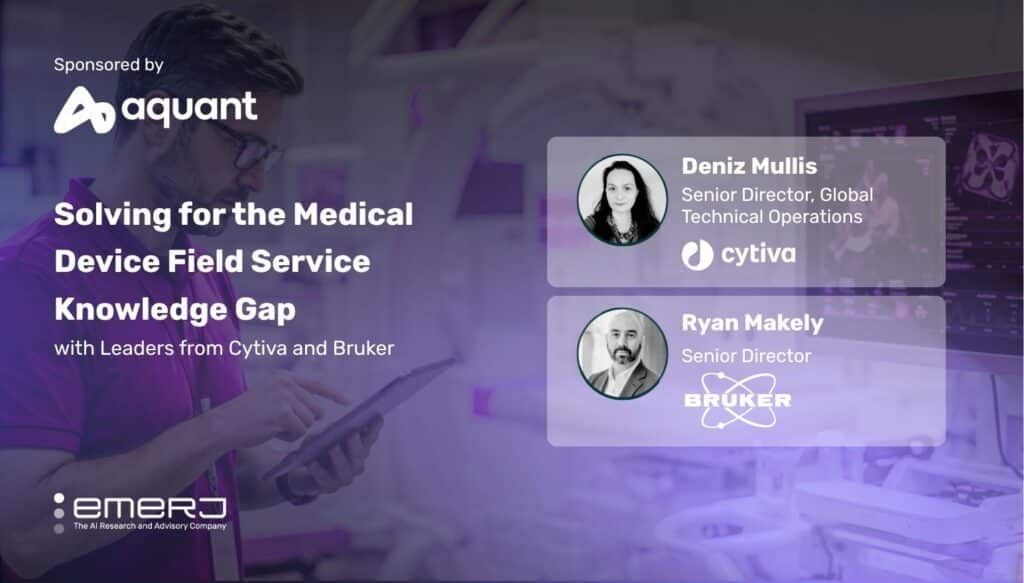
In a recent series on the AI in Business Podcast, Emerj featured Deniz Mullis, Senior Director of Global Technical Operations at Cytiva, and Ryan Makely, Senior Director of CALID Service at Bruker, to examine how medical‑device service organizations can sustain reliability amid rising product complexity and accelerating knowledge loss.
This article examines four critical insights shaping AI-enabled service performance in medical devices:
- AI-consumable knowledge capture for service continuity: Capture expert judgment, diagnostic intuition, and field learnings in a structured, maintained system to preserve decision patterns as tenure declines and ensure consistent guidance across the service organization.
- Structured device knowledge to scale field performance: Convert fragmented post‑launch learnings into a maintained, accessible knowledge backbone to deliver consistent, product‑specific guidance across geographies, experience levels, and installation contexts.
- Remote AI‑enabled diagnostics for efficient fault resolution: Structure device documentation and resolve contradictions so AI can support remote triage, equip technicians with accurate pre‑arrival context, and reduce avoidable repeat visits and unnecessary parts use.
- Change‑aligned service workflows to ensure AI adoption: Embed technician feedback, SME review, source transparency, and formal change‑management practices into daily operations to build trust in AI‑generated guidance and ensure sustained workflow integration.
Listen to the full episodes below:
Episode 1: Building the Infrastructure Behind AI-Enabled Field Service – with Deniz Mullis of Cytiva
Guest: Deniz Mullis, Senior Director, Global Technical Operations at Cytiva
Expertise: Technical Operations; Field Service; Service Delivery; Product Support
Brief Recognition: Deniz Mullis is Senior Director of Global Technical Operations at Cytiva, where she leads global technical operations, Services R&D, field escalations, technical training, and product service readiness across a team spanning three continents. She previously spent more than 20 years at Haemonetics, ultimately serving as Director of Global Field, Product Support & Depot Services, overseeing field service, depot, refurbishment, spare parts, and product support operations across North America, Europe, Asia, and Australia/New Zealand. She holds an MS in Biomedical Engineering from the University of Minnesota and a BS in Electrical Engineering and Computer Science from the University of Wisconsin-Madison.
Episode 2: Closing the Medical Device Knowledge Gap with AI Driven Field Service – with Ryan Makely of Bruker
Guest: Ryan Makely, Senior Director, CALID Service at Bruker
Expertise: Service Operations; Field Service; Service Enablement; Process Excellence
Brief Recognition: Ryan Makely is Senior Director, CALID Service at Bruker, with experience leading service operations and field service organizations across scientific and life sciences companies. Previously, as Director of National Service at Metrohm USA, he led field service, technical support, technical training, and service sales. He holds an MBA from DePaul University and a BS in Chemistry from Indiana University Bloomington.
AI-Consumable Knowledge Capture for Service Continuity
Deniz Mullis opens her episode by describing a recurring operational problem: when experienced technicians leave, the organization loses years of practical judgment that newer staff cannot immediately replace. Shorter tenure reduces the number of people with deep device familiarity, and the impact shows up in troubleshooting speed and service consistency. Ryan Makely adds that the loss is not only information but applied judgment — the pattern recognition and real‑world decision‑making that rarely exists in documentation.
Deniz makes the risk explicit:
“There’s so much locked in terms of knowledge in a technician’s brain that goes with them when they leave. We’re seeing our service engineers not staying as long in roles, and the number of years of experience in the organization is going down, down, down over time. When one person goes, it’s not like there are two or three others with that level of knowledge still around. This is a real scenario we deal with every day, not something you think about a month before someone retires.”
— Deniz Mullis, Senior Director, Global Technical Operations at Cytiva
Deniz and Ryan surface a sequence to preserve continuity when tenure declines, and expertise is concentrated in a few individuals:
- Identify knowledge at risk: Map where a small number of technicians hold expertise that would vanish if they left — especially informal escalation paths and undocumented judgment calls.
- Build a maintained knowledge foundation: Consolidate manuals, bulletins, CRM records, and validated fixes into one accessible system, starting with new products where documentation is thinnest.
- Improve response before prediction: Use AI to get technicians further along the diagnostic path before dispatch, not to predict every failure.
- Involve technicians early: Bring field engineers into design and testing before rollout — their real troubleshooting questions are the best test of the system.
- Build a human feedback loop: Give technicians a simple way to flag bad answers, and close the loop by confirming when their feedback gets incorporated.
- Assign a change owner and track outcomes: Name one person accountable for adoption, and measure it through first-time-fix rate and time to resolution.
A common theme in the series is that continuity depends on systems that preserve both the information and the applied judgment technicians develop over time.
Structured Device Knowledge to Scale Field Performance
Ryan and Deniz both emphasize that the knowledge technicians rely on most is created after launch, once real failures and real troubleshooting begin. Early in a product’s lifecycle, failure modes are not yet documented, diagnostic paths are incomplete, and engineers across regions begin developing practical insights that rarely make their way into structured systems. When this post‑launch learning remains fragmented or informal, organizations cannot deliver consistent decision‑making across products, locations, or experience levels.
Ryan illustrates how this fragmentation manifests operationally, especially in early remote troubleshooting, where teams lack the documented failure modes, shared language, and comparable cases needed to narrow down the issue. Several conditions drive this fragmentation:
- Incomplete failure‑mode documentation — troubleshooting trees are still being built, and teams may not know the right diagnostic questions to ask.
- Inconsistent operator language — customers describe issues differently, creating ambiguity before troubleshooting even starts.
- Limited visibility into comparable cases — engineers often don’t know that someone else has already solved a similar issue.
- Restricted connectivity in regulated environments — technicians must rely on conversation rather than telemetry or system data.
Deniz highlights why this problem persists even after organizations deploy AI‑enabled knowledge tools. In her own experience applying an AI layer to enterprise documentation, contradictions across manuals, bulletins, and eras surfaced immediately, revealing how knowledge created by different authors and at different times drifts without continuous human maintenance.
She stresses the importance of daily field feedback, designated reviewers who incorporate corrections, and communicating updates back to technicians so new learnings become shared organizational guidance rather than isolated personal practice.
Makely’s own words reinforce the consequence of failing to build and maintain this structure:
“Knowledge is rarely captured in a structured and accessible way. More often than not, organizations keep that information in someone’s head, on a documented sheet of paper, or maybe in CRM if they’re doing really well. Whether an engineer in Pennsylvania can access what someone learned during a similar installation in California can be difficult if they haven’t spoken to each other directly. Without structured knowledge, it becomes my opinion versus your opinion, and that makes it exceedingly difficult to solve issues consistently.”
— Ryan Makely, Senior Director, CALID Service at Bruker
A maintained, accessible knowledge backbone is what enables consistent decision‑making across products, regions, and experience levels.
Remote AI-Enabled Diagnostics for Efficient Fault Resolution
Ryan’s episode isolates a different operational exposure: remote diagnostics determine the quality of the dispatch decision.
If teams can narrow the issue before arriving on site, technicians show up with the right context, the right parts, and a realistic chance of resolving the problem on the first visit. If they cannot, the entire service cycle becomes reactive, with longer resolution times, higher cost‑to‑serve, and greater customer frustration.
The guests define requirements for AI‑supported remote diagnostics:
- Strengthen case narrowing before dispatch — use AI to help technicians begin troubleshooting from a more advanced starting point, informed by comparable cases and validated guidance.
- Improve parts readiness — better triage reduces the likelihood of arriving without the correct components, especially in lean inventory environments.
- Support faster, more accurate resolution — clearer diagnostic starting points help reduce repeat visits and shorten time‑to‑resolution.
Ryan explains that early troubleshooting often begins without enough information to pinpoint the issue. Operators vary widely in how they describe problems: some are highly familiar with the system and expect support to “start from step nine.” In contrast, others cannot use the device’s technical vocabulary.
In regulated environments, instruments often cannot be connected because customers restrict data access for security and compliance reasons. Without telemetry or system data, remote teams must rely entirely on verbal walkthroughs — a constraint that makes the dispatch decision more dependent on technician judgment and the quality of available guidance.
Ryan captures the consequence of remote diagnostics failure:
“If remote diagnosis fails, we’re likely going to have a return visit. I’m not going to a site carrying a thousand parts, and organizations are getting leaner in what they keep. So if we diagnose on site, especially with new technology, it’s not always guaranteed we can solve it there anyway. More often than not, poor remote troubleshooting means downtime for the customer, frustration for the operator, and unnecessary travel or part consumption for the service team.”
— Ryan Makely, Senior Director, CALID Service at Bruker
Organizations that haven’t moved on this are already behind competitors that offer customers self-service troubleshooting access, and the gap compounds retention and customer expectations. Ryan states it as an urgent issue: “If you haven’t moved, you’re late… it should have been six months ago.”
Change-Aligned Service Workflows to Ensure AI Adoption
Deploying is ultimately a change‑management effort that succeeds when service workflows, field expectations, and daily operating rhythms are aligned to it. Both guests agree on this point and state that technicians will not adopt a new system simply because it exists.
Medical device services are already saturated with information, processes, and tools, as Deniz notes. Still, durable adoption requires meeting users where they are, embedding feedback into their daily work, and making the tool feel like an extension of how they already solve problems.
Deniz speaks from experience, as her team initially assumed a new AI‑assisted knowledge tool would be immediately welcomed. Instead, they found that technicians were too busy to change habits without clear incentives, involvement, and trust. Adoption accelerated only when the field was invited into the development process, asked to test real troubleshooting scenarios, and given ownership over how the tool evolved. Transparency also mattered: technicians needed to see where answers came from, how feedback was reviewed, and when their suggestions were incorporated.
Deniz describes the human dimension:
“There’s a lot of psychology associated with change management and meeting users where they are mentally. We had this naive idea that we’d give the field a new shiny object, send an email, and they’d all flock to it. The reality is they’re very busy people, constantly inundated with things to remember. We had to embed feedback loops and involve them early so they felt invested. Without change management, adoption would have been slow, and the benefits would have taken far longer to materialize.”
— Deniz Mullis, Senior Director, Global Technical Operations at Cytiva
AI‑supported decision tools become durable when organizations treat them as part of the service workflow, not as an add‑on. The mechanisms that make AI adoption durable and aligned with field practice surface from the conversations:
- Field‑driven accuracy: Technicians need a way to correct and refine guidance as part of real troubleshooting, not after the fact.
- Expert validation: SMEs must have clear ownership of reviewing feedback, reconciling inconsistencies, and updating guidance.
- Transparency of sources: Technicians adopt AI tools when they understand where answers come from and how their input shapes future recommendations.
- Operational change discipline: Durable adoption requires structured communication, field champions, training, and closed‑loop reinforcement.
Deniz names the specific gap in her own rollout: her team assigned a project manager and technical lead from day one. Still, it didn’t formally assign a change manager — using a structured framework like ADKAR — until midway through the project. In hindsight, she’d make that a day-one role, not a mid-project fix: someone explicitly responsible for mapping which stakeholder groups need which message, when, and through what channel.
Durable AI adoption depends on aligning service workflows, feedback mechanisms, and change‑management practices so technicians trust the guidance, rely on it daily, and help improve it over time.