

This interview analysis is sponsored by Riskified and was written, edited, and published in alignment with our Emerj sponsored content guidelines. Learn more about our thought leadership and content creation services on our Emerj Media Services page.
Fraud rings evolve faster than quarterly policy cycles. Abuse exploits the gaps between siloed teams. And every false positive that blocks a legitimate customer is a churn event no one owns. For large enterprises, the math is simple: human‑only risk operations cannot keep pace with modern abuse patterns — and the financial drag of pretending they can is accelerating.
The numbers prove the crisis is compounding: the FBI’s IC3 recorded $16.6 billion in losses from 859,532 internet crime complaints in 2024 — a 33% increase in a single year. The FTC found that consumer fraud losses hit $12.5 billion in 2024, driven not by more reports, but by a surge in the share of victims who actually lost money — jumping from 27% to 38% in one year.
Within organizations, the ACFE found that the typical fraud case runs undetected for a full 12 months and that organizations lose an estimated 5% of annual revenue to fraud each year, with more than half of all cases enabled by absent or overridden internal controls. For large enterprises, the math is simple: human-only risk operations can no longer keep up — and the cost of pretending otherwise is compounding.
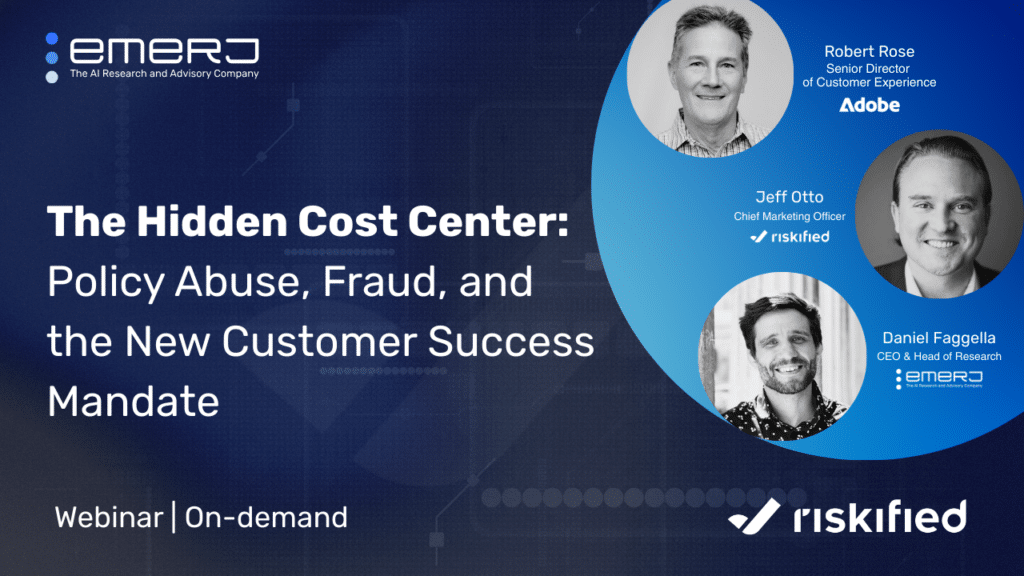
Emerj’s Daniel Fagella was joined by Jeff Otto, CMO at Riskified, and Robert Rose, Senior Director of Customer Experience at Adobe, to examine how large enterprises can modernize policy enforcement and customer treatment in an environment where abuse evolves faster than human teams can respond. Their conversation focused on the operational bottlenecks that keep CX, fraud, and finance teams misaligned, and the emerging role of unified policies, identity intelligence, and real‑time AI in closing those gaps.
This article examines how CX, fraud, and finance leaders can modernize policy enforcement and customer treatment through unified policies, identity intelligence, and real‑time AI.
- Policy backbone alignment: Consistent, shared policies across channels eliminate CX fraud friction and enable scalable, trust‑preserving decisions that protect revenue and customer loyalty.
- Identity‑based decisioning: AI‑driven identity resolution separates loyal customers from abusers and consolidates multi‑account fraud, allowing differentiated treatment that reduces loss while accelerating high‑value growth.
- Real‑time operational intelligence: Adaptive AI systems continuously evaluate behavioral signals and adjust safeguards and experiences, replacing slow periodic reviews with rapid refinements that strengthen margin and operational resilience.
Guest: Robert Rose, Senior Director of Customer Experience at Adobe
Expertise: Customer Success, Technical Support Operations, Knowledge Management, Service Transformation
Brief Recognition: Robert Rose leads enterprise paid support for Adobe’s Creativity and Productivity Solutions business, where he created and scaled the company’s global paid support program for Digital Media solutions. Across a career spanning leadership roles at Adobe, NICE, EMC, and Symantec, Rose has led large-scale support and customer success transformations, including global technical support organizations, knowledge management systems, and customer experience initiatives. Beyond industry leadership, he served as Adjunct Faculty at Utah Valley University, where he received a Teacher of the Year award, and holds a Bachelor of Science in Business from the University of Phoenix.
Guest: Jeff Otto, CMO at Riskified
Expertise: AI-Powered Risk Intelligence, B2B Marketing Strategy, Fintech Marketing, Financial Services Technology
Brief Recognition: Jeff Otto serves as CMO at Riskified, leading global marketing for an AI-powered ecommerce risk intelligence platform serving enterprise brands. Prior to Riskified, he led marketing at Marqeta and spent more than seven years at Salesforce building and scaling industry and product marketing across financial services, healthcare, and enterprise technology, following earlier leadership experience within Morgan Stanley’s technology and data division. Otto earned an MBA in Finance from the McCombs School of Business at the University of Texas at Austin, where he was a Venture Fellow and a Dean’s Award recipient.
Policy Backbone Alignment
Enterprises often assume policy enforcement breaks down because policies are unclear. Rose argues the real issue is that different teams interpret the same policy differently, creating operational noise that compounds across channels. Support agents optimize for satisfaction, fraud teams optimize for loss prevention, and finance teams optimize for margin protection. Without a shared backbone, each team makes decisions that make sense locally but create inconsistency system‑wide.
Rose’s perspective points to a practical framework leaders can apply:
- Map where policies diverge across channels and teams
- Identify which decisions create the most downstream rework or escalations.
- Standardize the interpretation of those decisions first, not the entire policy library.
- Ensure every channel — human or automated — uses the same enforcement logic.
This is the operational alignment Rose says most enterprises are missing. He describes the consequences directly:
“Support seems to inherit that ambiguity, and this often creates backlogs. It creates inconsistent resolutions. It creates tension between the customer experience teams that are chasing that satisfaction goal and the risk teams that are looking to prevent loss. When our policies aren’t clear, and they aren’t equally managed across all of those channels, our trust and our reputation suffer.”
— Robert Rose, Senior Director of Customer Experience, Adobe
Otto reinforces the same dynamic from the fraud side. When CX and fraud interpret the same rule set differently, fraud teams absorb the downstream impact — more manual review, more escalations, and more cases that should never have reached them. He notes that enterprises often underestimate the operational drag caused by inconsistent policy execution.
The shared argument from both leaders is straightforward. AI can scale enforcement, but only after the organization aligns on a single policy backbone that governs decision-making across CX, fraud, and finance. Without that alignment, automation amplifies inconsistency instead of eliminating it.
Identity‑Based Decisioning
Otto argues that most enterprises still make decisions at the account level, even though abuse rarely operates that way. Fraud rings, serial refund abusers, and opportunistic customers all mask their behavior behind multiple emails, devices, and addresses.
What appears to be normal support volume is often the work of a single coordinated actor. Otto’s point is that without identity‑level resolution, enterprises cannot distinguish a loyal customer from a high‑risk one — and both groups end up treated incorrectly.
He illustrates the scale of the problem:
“You start to connect all those identity signals together, and what ends up happening is you can resolve identities that look like 50 different people. Turns out it’s one person sitting in their garage scam center stealing millions of dollars.”
— Jeff Otto, CMO, Riskified
Identity‑based decisioning is not just a fraud capability. Rose notes that CX teams also struggle when they cannot see a customer’s full history, intent, and entitlements in real time. Agents default to empathy because they lack the context required to enforce policies confidently. That dynamic creates inconsistent outcomes and increases the volume of escalations that fraud teams must later unwind.
For leaders, the shift to identity‑level decisioning follows a practical sequence:
- Consolidate customer signals across devices, emails, addresses, and behavioral patterns.
- Cluster those signals into unified identity profiles rather than isolated accounts.
- Tier identities into trust levels that guide both CX treatment and fraud safeguards
- Apply differentiated experiences — frictionless for high‑trust customers, calibrated for risky ones.
This is the operational logic both leaders converge on. Identity intelligence reduces loss, but it also reduces unnecessary friction for legitimate customers. The same capability that collapses multi‑account fraud into a single entity also enables faster resolutions, fewer escalations, and more consistent policy enforcement across channels.
Real‑Time Operational Intelligence
Enterprises still operate on a review cadence that assumes abuse patterns change slowly. Rose and Otto argue the opposite. Abuse adapts in real time, and the systems meant to detect it often move on quarterly or monthly cycles. That gap creates avoidable loss on the fraud side and unnecessary friction on the CX side — both symptoms of the same underlying issue: decisions are being made on stale information.
Rose explains why periodic review is no longer viable:
“You need a system that evaluates all of these automated checks, adaptive safeguards, and adaptive UI changes. It’s not just about speed, it’s about fairness and proper adjustment at scale. Humans don’t do that as well as machines.”
— Robert Rose, Senior Director of Customer Experience, Adobe
Otto approaches the same problem from a risk perspective. When identity, behavior, and policy signals are evaluated only after the fact, fraud teams are forced into cleanup mode — reviewing cases that could have been prevented if the system had adapted earlier. He notes that real‑time intelligence is not about adding more rules, but about allowing safeguards and customer experiences to shift dynamically as patterns emerge.
For leaders, the shift to real‑time intelligence becomes actionable when framed as a sequence:
- Replace scheduled policy updates with continuous signal evaluation.
- Allow safeguards and UI elements to adjust automatically based on risk level.
- Use identity‑level insight to change the experience before abuse occurs.
- Treat manual review as an exception path, not the default workflow.
This is the operational shift both leaders emphasize. Real‑time intelligence reduces loss while reducing friction for legitimate customers by ensuring safeguards are applied only when needed. The same adaptive system that tightens controls for risky identities can eliminate unnecessary steps for high‑trust customers — improving margins and the customer experience simultaneously.