

Quest Diagnostics reported $11 billion in net revenues and processed about 244 million test requisitions in 2025. The company serves roughly one in three U.S. adults each year and about half of U.S. physicians and hospitals. At this scale, even incremental improvements in laboratory and customer service workflows can affect substantial volumes of work.
Quest reported that its company-wide Invigorate program met its 3% annual cost savings and productivity improvement target in 2025, reflecting the combined results of the program’s initiatives, including AI and automation.
In June 2024, it completed the acquisition of select PathAI Diagnostics lab assets to advance AI and digital pathology. In March 2025, it announced a collaboration with Google Cloud to improve data analytics and explore generative AI across research, customer experience, and operations, with several of those applications still under exploration.
This article examines two internal AI use cases at Quest Diagnostics:
- Supporting Pap test slide review with AI-assisted digital cytology: AI selects images from digitized Pap test slides for review by cytologists and pathologists.
- Supporting customer service calls and emails with AI: A virtual agent handles routine logistics calls, while AI tools help route incoming emails and help representatives find answers faster.
We begin by examining how Quest applies AI-assisted digital cytology to high-volume cervical cancer screening, where specialist time is scarce.
Supporting Pap Test Slide Review with AI-assisted Digital Cytology
Pap test slide review depends on cytologists and pathologists, making specialist staffing a factor in how many slides a lab can review.
The American Society for Clinical Pathology’s 2024 vacancy survey found that the vacancy rate in U.S. cytology departments fell from 13.2% in 2022 to 11.6% in 2024. In the 2022 survey, respondents reported that filling cytology staff positions took more than 12 months.
For labs evaluating the workflow, the question is whether existing staff can review more slides and deliver results sooner while maintaining or improving screening performance.
On Quest’s April 2026 earnings call, CEO Jim Davis estimated that 60% to 70% of the company’s AI and automation efforts were focused on its labs. He described how Quest looks for opportunities to use AI by asking whether what specialists examine under a microscope can be captured in digital images that algorithms can analyze.
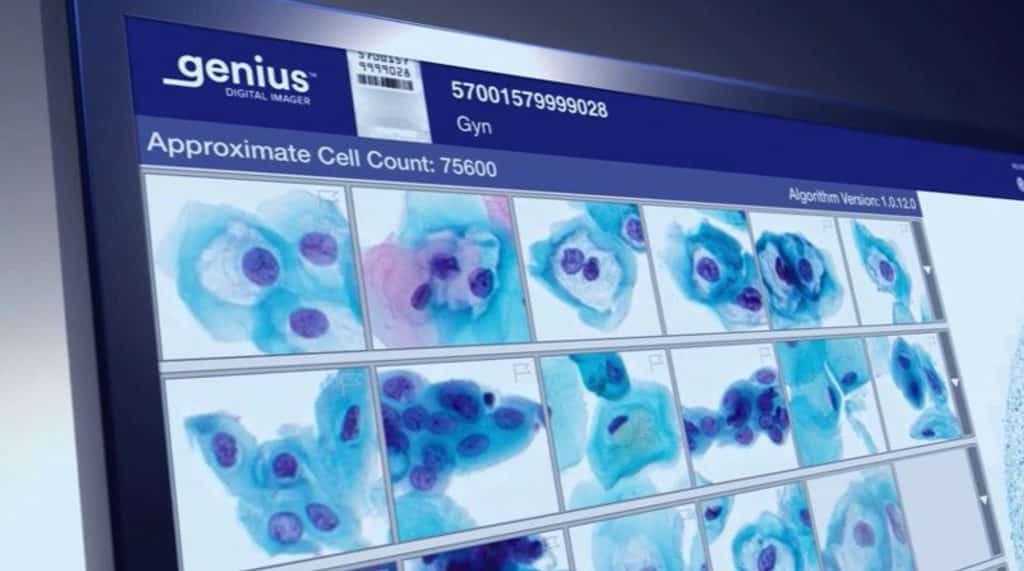
Quest uses the Hologic Genius Digital Diagnostics System in cervical cancer screening. Quest describes the system as using an AI algorithm with digital imaging to help identify precancerous and cancerous cells.
According to the U.S. Food and Drug Administration’s (FDA) review, it works in three connected steps:
- Imaging: In conventional review, specialists examine the glass slide under a microscope. With Genius, a digital imager scans each stained Pap test slide.
- AI-assisted selection: A deep learning model selects images of cells and cell clusters for the review gallery and provides a cell count to help specialists assess whether the sample is adequate.
- Professional review: Cytologists and pathologists review the full gallery on high-resolution stations and are responsible for the diagnosis.
Hologic describes secure remote sharing of cases, a capability of the digital imaging infrastructure rather than of the AI itself, which can help labs distribute review work across locations.
In its 2024 annual report, Quest described how it uses AI to separate specimens with no evidence of microbial growth so medical scientists can focus on specimens more likely to indicate disease.
In its 2023 Investor Day presentation, Quest reported that it had reduced the microbiology workflow from eight steps to two, improved turnaround time for negative cultures by 40%, and reduced the full-time staffing required for the workflow by about 40%. The figures reflect the combined effects of automation and AI.
In a four-site study of 1,960 evaluable slides, sensitivity for high-grade lesions or worse was 81.5% with the Genius system, compared with 74.0% for manual review.
At the same threshold, specificity fell from 97.2% with manual review to 94.8% with Genius, a statistically significant difference. The digital system detected more high-grade abnormalities, but the lower specificity can also mean more slides without high-grade abnormalities are flagged for further review.
A retrospective study at ProPath, a Dallas pathology laboratory, compared Pap test workflows before and after the lab introduced Hologic’s Genius Digital Diagnostics System. Average daily review volumes were similar, while cases reviewed per cytologist per day rose from 74.5 to 94.7 and the average number of cytologists working per day fell from 10.4 to 8.1. The time from specimen accession to final sign-out also fell across diagnostic categories.
Hologic funded the study and employed one co-author. The study covered one lab and included about eight months of data after implementation. The authors did not use biopsy data to confirm the increase in disease detection, and the before-and-after comparison could not isolate AI’s contribution to the workflow changes.
In its February prepared remarks, Quest said it had implemented the Genius system at two laboratories and planned to expand it to several more that year. On the July earnings call, Davis said Quest had recently installed the system at two more locations, following implementations at about half a dozen sites over the previous year.
At its 2025 Investor Day, Quest projected that implementing Genius would improve resource productivity by more than 40%. The February and July updates described rollout progress and gave no measured productivity result.
Supporting Customer Service Calls and Emails with AI
Quest’s customer service operation connects the physician offices, hospitals, and patients it serves with its labs and courier network. Much of that work is routine: physician offices, for example, schedule courier pickups by calling a central line and saying “specimen pickup” to reach dispatch. Requests like these are the kind of high-volume, repeatable contact a service operation at Quest’s scale has to absorb.
Quest’s contact centers handled 13.2 million interactions in 2024, up from 12.2 million in 2023. Phone calls accounted for 71% of interactions in 2024. In its 2025 Investor Day presentation, Quest showed that calls per 100 requisitions fell from 6.2 in 2022 to 5.5 in 2023 and held at 5.5 in 2024, an 11% reduction from the 2022 baseline.
On Quest’s Q3 2026 earnings call, Davis estimated that wage inflation would be 3% to 4% in 2026. He said wage inflation puts at least $120 million in cost pressure on Quest each year and that the company uses its Invigorate program to help offset that pressure.
Across its filings and earnings calls, Quest has described three AI applications in use:
- Answer retrieval for representatives: In its 2024 annual report, Quest said it is broadening its use of AI in customer service to help representatives access answers more quickly.
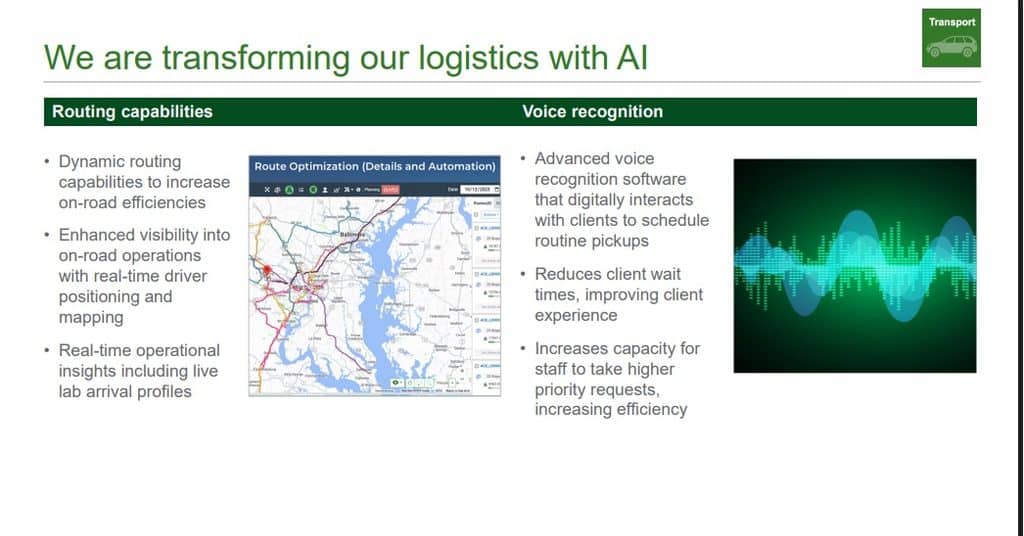
- A virtual AI agent for logistics calls: Davis said the agent handles routine logistics calls. Quest’s 2025 Investor Day describes voice recognition software that interacts with clients to schedule routine pickups, which it says reduces client wait times and frees staff for higher-priority requests. Quest has not said whether this is the same tool as the virtual agent, though both target routine logistics calls.
- AI triage for customer service email: Davis described customer service agents using AI to triage and route customer emails to speed responses.
Quest describes three changes to its customer service workflow:
- A virtual agent handles routine logistics calls.
- AI helps triage and route incoming emails.
- Representatives use AI to find answers more quickly.
On impact, Quest has given two headline figures, both self-reported. Davis said the virtual AI agent has reduced routine logistics calls by “up to” 50%, a best case rather than an average. He reported a 40% productivity gain in Q1 2026 among customer service agents who used AI to triage emails, without a published methodology or comparison group.
Beyond those figures, Quest has not named the vendors or models behind these tools, or disclosed which call types the agent covers, adoption levels, volumes, costs, or AI’s share of Invigorate savings. Customer service AI has appeared in its reporting from 2023 through 2026, which shows sustained attention rather than proven scale.
Quest’s examples suggest a simple sorting rule for leaders deciding where AI belongs in a contact center:
- Routine, repeatable spoken requests: Route to a virtual agent first, as Quest has done with logistics calls.
- Unstructured written requests: Use AI to triage and route, and keep a person on the resolution, as Quest has done with email.
- Live requests that reach a representative: Keep the person on the call and use AI to find answers faster, as Quest describes in its annual report.
- Measurement: Track calls per 100 requisitions to account for changes in testing volume. Measure agent productivity against a defined baseline and, where feasible, compare it with that of a similar group working without the AI tools.
This analysis examines the following lessons enterprise leaders can draw from Quest Diagnostics’ AI adoption:
- Check what the digital input preserves: Before choosing an algorithm, confirm that the digital record captures the details specialists need to make a decision.
- Set the boundary for automation: Define which cases AI can route or complete, which findings specialists must interpret, and when to escalate uncertain cases.
- Measure each tool against its own baseline: Track changes in throughput, quality, and cost for the workflow the tool affects, and report those results separately from program-wide savings.